





Nowadays, a big challenge for businesses is data. You may wonder how data can be a challenge if it is a weapon for strategic business opportunities.
In the past, businesses made decisions based on previous experience; today, their decisions are data-driven. To make the most out of huge amounts of data, companies need to handle it properly to be able to identify insights and build intelligent strategies to ensure their competitive edge.
To enhance better decision-making, it is important to collect data from various sources, integrate it, and analyze it in a way that will contribute to your business intelligence. Let’s figure out what BI stands for, why it is important, and how to develop a successful business intelligence strategy.

What Is a Business Intelligence Strategy?
Before diving into the details of strategy, it’s crucial to understand what stands behind business intelligence (BI). BI refers to the tools and strategies used to analyze data in a company. It allows businesses to look at past performance, understand current trends, and make predictions for the future.
A business intelligence strategy is a plan for how a company can use its data to benefit from it. This data comes from various sources like HR, supply chain, manufacturing, finance, and customer relationship management. A successful BI strategy brings together people, processes, and technology to make the most of this data.
Key elements of a business intelligence strategy
A successful BI strategy focuses on three key areas: business, data, and people. So, the main elements of it include:
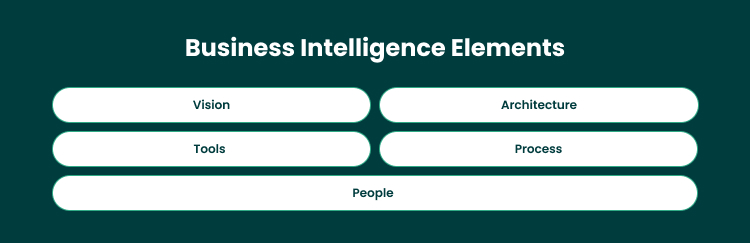
- Vision: Clearly define the goals of your BI strategy. For example, is it focused on reporting, analytics, or both? Make sure everyone is aligned with this vision.
- People: Get executive support for your BI strategy. Make sure leadership understands the benefits and ROI. Assign roles to staff and determine what data each department needs.
- Process: Review your current data setup and identify gaps. Outline the steps to move from your current state to the desired future state. Use this to create a strategic roadmap.
- Architecture: Establish the technical framework, including data requirements, security, and system integration.
- Tools: Choose the right BI tools and software based on your company’s needs after defining your strategy and vision. These tools will help bring your business intelligence strategy to life.
Why Do You Need a Business Intelligence Strategy?
The global business intelligence (BI) market is expected to grow from $29, 22 billion in 2023 to $54, 9 billion by 2032, with an annual growth rate of 9,1%. The global adoption rate of BI tools is around 26%, with over 33% of large-sized businesses employing decision intelligence.

This shows how quickly BI tools are being adopted across the world. However, without a solid BI strategy in place, successfully rolling out a BI project becomes much more difficult.
To understand why a BI strategy is key to your company’s success, it helps to look at what happens when you don’t have one. With so much data coming from different systems and sources, businesses can easily face information overload. Without a clear strategy, that data can be hard to manage and use effectively.
What’s more, the amount of data being generated worldwide is skyrocketing. According to recent statistics, the total amount of data created, captured, copied, and consumed globally was 64.2 zettabytes in 2020. This figure is projected to grow to more than 180 zettabytes by 2025. The rapid growth is caused by more digital devices, better internet access, and the increased use of data-heavy technologies.
If data isn’t properly managed, it can lose its quality and lead to various issues that need fixing. This is where a BI strategy comes in – it helps turn raw data into meaningful insights that can guide strategic decisions.
A successful business strategy depends on your company’s goals. Maybe you want to improve employee productivity or gain insights into your customers’ behavior. Determining your goal will help you accurately develop your BI strategy.
With a solid BI strategy, you can:
- Spot issues early by tracking KPIs
- Make faster, data-driven decisions
- Understand business needs and market demand
- Discover new ways to use your data
- Assess development risks
- Improve operational efficiency
- Combine data from different sources into one system
- Enhance marketing and sales through competitive analysis
Business intelligence tools can be seamlessly integrated into business applications like CRM and ERP, allowing you to analyze data all in one place without having to jump between different tools. This streamlined approach has already helped many industries improve their operations and make smarter decisions by leveraging the power of a well-executed BI strategy.
Are you ready to transform your data into actionable insights? Contact us to discover how a business intelligence strategy can drive your company’s success.
How to Develop a Business Intelligence Strategy: Key Steps
As mentioned above, your business intelligence strategy needs to be aligned with your business goals. We outlined the steps to make your BI strategy more effective.
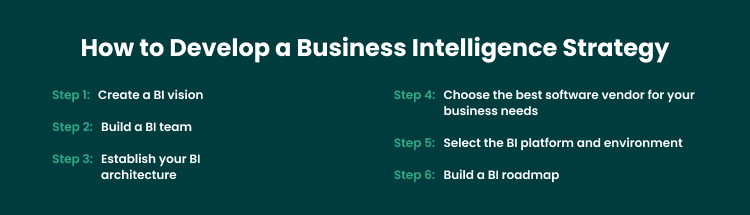
Step 1: Create a BI vision
To create a clear vision for your BI strategy, start by understanding your current situation. By analyzing where you stand and connecting data from various sources, you’ll get a solid foundation. From there, you can set your goals and priorities, which will show how business intelligence can boost your business performance. This process will guide you in setting realistic expectations.
At this stage, it is important to determine the following:
- What data will we gather?
- Who will be part of the BI process?
- How will the BI strategy fit into the company’s operations?
- How will we deliver BI solutions?
- What BI tool should we choose?
- What KPIs do we need to track?
- What will BI lifecycle management look like?
Answering these questions will set you up for a successful business intelligence strategy.
Step 2: Build a BI team
The BI team is responsible for uncovering insights from data, analyzing it, and making it accessible to end-users. In large companies, there are usually different BI roles, but if you’re on a tight budget, these roles can be combined into one position. If you’re creating an in-house team, here are the key roles to consider:
- BI Project Manager – acts as a link between business and tech teams.
- BI Architect – designs the BI infrastructure by turning business needs into a data warehouse.
- BI Analyst – mines and analyzes data to find valuable insights.
- ETL Developer – manages the ETL processes that feed data into the warehouse.
- Data Visualization Analyst – creates clear, informative visuals from the analyzed data.
- System Administrator – sets up and monitors the hardware.
If you’re looking to outsource a BI team, we can provide a dedicated team tailored to meet your specific needs and goals. Let us help you unlock the full potential of your data.
Step 3: Establish your BI architecture
Different architectural approaches are available depending on the required configurations. According to Chartio’s eBook Cloud Data Management, four stages of data sophistication are relevant for building data management software:
- Source data (siloed data from datasets like Excel spreadsheets, Salesforce, Hubspot, etc.)
- Data lake (a single repository for storing unstructured data from data sources. Data in the lake is unstructured and is not ready for analysis).
- Data warehouse (it is a single source of truth where data is structured, cleaned, and ready for consumption).
- Data mart (it is a data set designed for specific use cases).
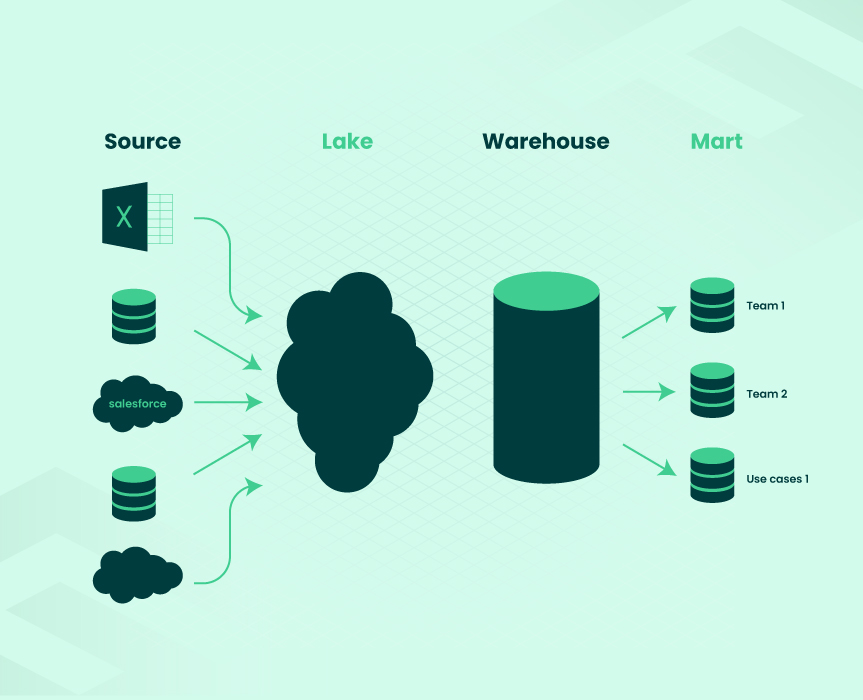
In the picture below, you can see a pipeline from where data 1) is extracted, then 2) it is loaded to the lake or 3) warehouse, and finally, 4) it is categorized into marts to be used explicitly by different departments (HR, PM, Sales, Marketing, etc.). The ultimate data flow destination is the end-user interface represented via reporting tools and interactive dashboards.
Different architectural approaches have specific capabilities. Depending on the growing organizational needs within your company, you can select one-tier, two-tier, and three-tier architecture:
- One-tier architecture is designed without domain-specific data mart layers (see above).
- The two-tier architecture is focused on adding data mart levels between the data warehouse and the user interface.
- The three-tier architecture allows multidimensional data analysis with the help of OLAP cubes (online analytical processing), which means that data is represented from multiple dimensions. To put it simply, data is divided hierarchically into categories and subcategories.
Therefore, at this stage, you need to define your data sources that need to be integrated, and define the type and architecture of the data warehouse (whether your business needs additional data mart layers, OLAP).
Step 4: Choose the best software vendor for your business needs
We compiled several questions you need to ask your potential BI provider to evaluate their capabilities:
- Can the software/tool be integrated with your company’s existing systems?
- What deployment options does the solution offer: on-premises or cloud?
- Are there flexible user permissions for data fields?
- Is the software easy to use and navigate?
- Do your business requirements correspond to the software you select?
- Is the software scalable enough if your company’s demands grow?
- Are the dashboards customizable?
- Does a vendor offer training to all the users, not only the tech team?
Of course, there are additional factors to consider before making your choice. Leading BI tools like Oracle, Tableau, IBM, and Looker offer a wide range of features. However, it’s crucial to evaluate your business’s specific needs. Off-the-shelf solutions might not fully address your unique challenges and could include unnecessary features that don’t apply to your business.
While ready-made tools are quick and easy to implement, if you’re looking for a solution that can adapt to your business’s growth and changing needs, custom software development might be the best option for you.
But what about costs? Initially, ready-made BI tools can be cheaper than investing in custom BI software, but they can cost you much more in the long run due to the permanent subscription costs and maintenance. Moreover, the price for subscriptions from ready-made vendors can grow depending on the number of users involved.
Step 5: Select the BI platform and environment
There are deployment options available: on-premise, cloud, and hybrid. To define which options will best suit your business goal, let’s compare them.
- On-premise is a model where infrastructure is installed locally so that it is under your total control. So, if you have a particular use case and are concerned about high privacy and security, this type can be perfect for you.
- The cloud environment is a model where data processing and management are performed by third-party providers in the cloud, which eliminates the expenditures on hardware and infrastructure purchases. Data security threats are the main ones constraining businesses from adopting cloud computing.
- A hybrid cloud connects on-premises data centers and public clouds that are integrated. This solution best suits businesses that want to store their critical workloads on-premises (much more secure) and less sensitive resources on a cloud provider.
Cloud environment requires selecting the platform to deploy your business intelligence roadmap. Microsoft Azure, AWS, Google Cloud, and IBM Bleumix are leaders.
Step 6: Build a BI roadmap
A business intelligence roadmap is a visual document representing planned activities by dates, KPIs, deliverables, and milestones within the timeline. The roadmap should contain technical details and be attractive to end-users as well.

Challenges in Implementing a Business Intelligence Strategy
Implementing a BI strategy brings many benefits but can also come with challenges. Here are some common obstacles businesses face when rolling out BI:
- Data quality and integration: Making sure data is accurate and consistent can be tough. Bringing together data from different sources takes time, and sometimes you’ll need to clean and organize the data to fix any inconsistencies.
- Data governance and security: Managing data access and security is crucial. You’ll need to set rules for who can see and use the data, implement security measures, and follow data protection laws to keep sensitive information safe.
- Training: Not everyone will easily embrace BI tools. Some employees may find the tools complicated or lack the skills to use them well.
- Scalable infrastructure: As data grows, you’ll need a system that can keep up. Managing large amounts of data and making sure your infrastructure can handle it might require investing in better hardware or cloud solutions.
- Keeping pace with technology advancements: With BI tools constantly evolving, it’s important to stay informed about new developments. Continuous learning and adapting to new technologies will help you get the most out of your BI strategy.
As you can see, business intelligence implementation comes with hurdles. But now that you know what to expect, you’re better prepared to tackle them.
If you need support in making your BI strategy seamless, reach out to the Forbytes team. With our extensive experience, we’re here to help!
Must-Have Functions in Business Intelligence Software
- Data integration. To establish a solid database, BI software has to be designed with seamless data delivery and integration.
- Ad hoc analytics. This function is used for analyzing and answering a specific question. In contrast to traditional BI reporting, the ad-hoc analysis provides immediate and in-depth details about particular business processes and short-term decisions.
- Predictive analytics. Descriptive analytics is a traditional approach toward decision-making where historical data is analyzed. With predictive analytics, data scientists can forecast future events.
- BI dashboards. They are advanced reporting tools to display key business metrics via in-built, intuitive data visualization.
Looking for the right BI software? Let our expertise guide you in selecting and integrating the perfect solution to elevate your business performance.
Final Thoughts
If you want to make the most out of your data, apply a business intelligence strategy to foster effective, fast decision-making and increase revenue. The selection of appropriate technology and software platforms is only a part of BI. If you want to increase your ROI and reap all the benefits from the valuable insights it provides, follow the step-by-step BI strategy mentioned above.
Of course, each business has its specific needs; therefore, the strategy can be adjusted appropriately. With the right expert team, you will be able to achieve tangible results.
Let us know if you need a consultation – our tech talents help companies create solid solutions. Contact us to learn more about how we can help you.
Share:
-

-

-
Successfully copied

-


Anzhelika Danielkievych
Author
My mission at Forbytes is to help our IT experts share complex information in plain language. The articles we produce reflect our expertise and help readers keep pace with the market trends and insights. We strive to educate, inspire, and empower our audience through compelling content that tackles the intricacies of the IT world and makes it accessible to all.
FAQ
How to create a business intelligence strategy
Step 1: Create a BI VisionStart by understanding your current data situation. Analyze and connect data from different sources to set a solid foundation. Then, define your goals and priorities to see how BI can improve business performance. Determine key factors like what data to gather, who will be involved, and how BI will fit into your operations.Step 2: Build a BI TeamCreate a team responsible for gathering insights and analyzing data. Key roles include a BI project manager, BI analyst, ETL developer, and data visualization expert. If you have budget constraints, some roles can be combined, or you can outsource a dedicated team.Step 3: Establish Your BI ArchitectureChoose the right data structure for your BI strategy. Depending on your needs, you can implement a data lake, warehouse, or mart. This will help organize your data and prepare it for analysis. Different architectural approaches (one-tier, two-tier, or three-tier) are available depending on your data complexity.Step 4: Choose the Best BI SoftwareEvaluate potential BI tools by asking questions about ease of integration, deployment options (on-premise or cloud), user permissions, scalability, and customization. Consider if ready-made or custom BI software better fits your business needs.Step 5: Select the BI Platform and EnvironmentDecide whether an on-premise, cloud, or hybrid environment is best for your business. On-premise offers more control and security, while cloud options reduce infrastructure costs. A hybrid solution combines both, providing flexibility for your needs.Step 6: Build a BI RoadmapCreate a BI roadmap that outlines your key milestones, KPIs, and deliverables over time. This visual document will guide the implementation and track progress toward your BI goals.
How business intelligence and business analytics can help a firm refine their business strategy
Business intelligence (BI) and business analytics (BA) help companies refine their business strategies by turning data into valuable insights. They enable better decision-making, highlight trends and opportunities, and improve operational efficiency. BI and BA also enhance customer experience, support proactive risk management, and provide clear metrics for tracking success. Together, they allow firms to adapt, stay competitive, and fine-tune their strategies based on real-time data.






Let's Get in Touch




Forbytes created an app that allowed users to quickly measure themselves to be fitted for custom shirts. As a result, we could increase our speed, quality, and shirt output per week. Forbytes was dedicated to delivering a solution that accurately addressed our needs.

Forbytes’ engineers and team leads worked as part of our RnD group and were directly managed by our company directors. They were both proactive and adaptable, qualities that perfectly match our needs in our fast-growing and constantly evolving environment.

Forbytes has a strong process-oriented way of leading the company, with good respect for themselves and their managers. They made a choice not to become too big but build slowly on more qualified people, which is paying off.

Niklas Hammar
COO & Business
Development at Offerta.se

Our e-commerce site saw online inquiries and orders rise after working with Forbytes. The team used top-notch expertise to inform their suggestions and improvements. Constant communication, quick responses, and prompt delivery made for a smooth and enjoyable collaboration.

The Forbytes team was very professional and demonstrated a great understanding of the business aspects. All tasks were completed above expectations. Their experts were always available, and we never needed to wait for a response or a suggested solution.