




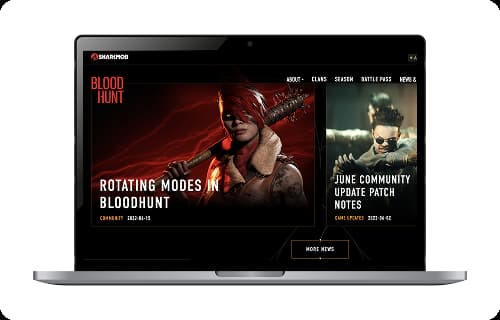
Sharkmob
As a game developer, Sharkmob had little experience with the actual ecommerce…
Lorem ipsum dolor sit amet consectetur. Sagittis ut est sed lectus proin pulvinar auctor ut sit. Commodo ut at id lacus turpis velit amet eget est.
Disconnected systems slow your teams, create errors, and make scaling a headache. Connect your ERP, CRM, e-commerce, and internal systems into one reliable data flow without manual work or integration chaos.

You use only a part of your ERP’s capabilities if it operates in isolation. We connect your ERP platform with systems such as CRM, eCommerce, logistics, finance, and third-party solutions to eliminate silos. This ensures synchronized, consistent data across departments, allowing your processes and operations to run on a single, reliable source of truth.
If the CRM system isn’t synced up with ERP, marketing, or billing, your sales team works with fragmented, outdated data. Forbytes connects CRM with other systems to automate lead flows, deal updates, invoicing, and the entire customer lifecycle. The guesswork is taken out of the equation, and your team makes decisions based on real, live data.
Messy integrations can create instability and a mountain of technical debt. We focus on building and connecting secure, scalable APIs that link your internal systems and third-party tools the right way. It turns your architecture into something that’s built for integration from the ground up, rather than a bunch of patchwork fixes held together by luck.
When you rely on dozens of point-to-point connections, it’s hard to stay organized. Our engineers can centralize the integration logic and automate complex workflows so that monitoring finally becomes manageable. Instead of fighting with dozens of fragile connections, you will operate from a single, scalable layer that grows alongside your business requirements.
It often happens that legacy systems cannot communicate with modern platforms, but replacing them is rarely practical. We integrate legacy software with modern APIs, cloud platforms, and third-party tools to enable seamless data exchange. This allows your existing systems to remain operational while becoming part of a connected, modern technology ecosystem.
Moving to the cloud services does not automatically create connected operations. Our team integrates SaaS platforms, cloud-native applications, and hybrid infrastructure to ensure consistent data flow across systems. Your ecosystem becomes coordinated and reliable, allowing teams to access synchronized data and operate efficiently across environments.
Manual EDI processing slows supply chains and increases the risk of transaction errors. We automate EDI integrations to streamline order processing, invoicing, shipment, partner communication, and more. This makes B2B transactions faster, more accurate, and compliant, while reducing operational friction between your business and external partners.
Manual workflows limit productivity and make scaling operations more expensive. Forbytes automates the internal and cross-system processes to eliminate repetitive tasks, reduce human errors, and accelerate operational cycles. As a result, your teams spend less time on manual data entry and approvals while your operations become more efficient and easier to scale.
| Integration Benefit | Business Impact |
|---|---|
| Real-time data | Accurate decisions and reporting |
| Reduced manual work | Faster operations, lower errors |
| Scalable architecture | Market growth without bottlenecks |
| Automated workflows | Teams focus on high-value tasks |
| Unified systems | Better collaboration across departments |
| Faster partner onboarding | Reduced operational risk |
As a game developer, Sharkmob had little experience with the actual ecommerce…
Lorem ipsum dolor sit amet consectetur. Sagittis ut est sed lectus proin pulvinar auctor ut sit. Commodo ut at id lacus turpis velit amet eget est.
Context and Challenge Our client, WeSports Group, is a leading Scandinavian group of brands…
Context and Challenge Our client, WeSports Group, is a leading Scandinavian group of brands…
Lorem ipsum dolor sit amet consectetur. Sagittis ut est sed lectus proin pulvinar auctor ut sit. Commodo ut at id lacus turpis velit amet eget est.2
Context and Challenge Our client, WeSports Group, is a leading Scandinavian group of brands…

Context and Challenge Our client, WeSports Group, is a leading Scandinavian group of brands…
System assessmentAudit your systems, data flows, and dependencies to identify risks and inefficiencies.
|
#2
|
Design & architectureDesign scalable and reliable integration patterns that support future growth.
|
#4
|
Testing & QAEnsure secure, stable, and accurate data exchange across all systems.
|
#6
|
|
#1
|
Integration strategyDefine which systems to connect, how, and in what order for maximum business impact.
|
#3
|
Incremental integrationDeploy integrations step by step to avoid downtime and operational disruption.
|
#5
|
Deployment & optimizationMonitor, improve, and scale integrations as your business evolves.
|
Receive a quick audit that identifies the compatibility and technical feasibility of your systems.

Not necessarily. While high-level guidance from your team is always a plus, our engineers are experts at mapping system dependencies, data flows, and potential bottlenecks during the consulting stage. You won’t need to spend weeks cataloging every internal process. We handle the technical discovery and build a clear integration project roadmap based on what we find on the ground.
We look for those compatibility roadblocks long before any code is actually written. If you’re running a legacy system that doesn’t have a native way to talk to other apps, we don’tjust hit a wall. Instead, we look at practical workarounds, things like custom API bridges, integration platforms, middleware layers, or even a phased update path. The goal is to get your data moving without forcing you into a massive, risky overhaul of systems that are otherwise working fine for your team.
We don’t just disappear and come back with a finished product. You’ll always have a clear look at what’s happening through shared docs, live trackers, and regular checkpoints. While our team handles the heavy lifting on the backend, you’re still the one calling the shots. You stay in the driver’s seat when it comes to setting priorities, approving timelines, and giving the green light on each phase of the rollout.
No. The system integration is built on a model that doesn’t add to your team’s daily workload. We take full ownership of the system mapping, the architecture design, the testing, and the ongoing monitoring of each system. This lets your internal team stay locked in on their core management goals. Your involvement is really just about high-level strategic alignment and the final green light; we handle the end-to-end execution.
Absolutely. In our system integration projects, we prioritize a modular and scalable architecture, making future additions low-risk and straightforward. Because each integration is built as a standalone, connectable module, your ecosystem can grow or change without compromising the stability of your existing setup.
Security is built into our system integration solutions from day one. We use encrypted connections and strict role-based access to keep your data safe, whether it’s moving between apps or sitting in a database. We also map our process to whatever specific regulations or compliance rules you have to follow. The goal is to make sure every connection we build is locked down and meets the internal and market standards without exception.




Forbytes created an app that allowed users to quickly measure themselves to be fitted for custom shirts. As a result, we could increase our speed, quality, and shirt output per week. Forbytes was dedicated to delivering a solution that accurately addressed our needs.

Forbytes’ engineers and team leads worked as part of our RnD group and were directly managed by our company directors. They were both proactive and adaptable, qualities that perfectly match our needs in our fast-growing and constantly evolving environment.

Forbytes has a strong process-oriented way of leading the company, with good respect for themselves and their managers. They made a choice not to become too big but build slowly on more qualified people, which is paying off.

COO & Business
Development at Offerta.se

Our e-commerce site saw online inquiries and orders rise after working with Forbytes. The team used top-notch expertise to inform their suggestions and improvements. Constant communication, quick responses, and prompt delivery made for a smooth and enjoyable collaboration.

The Forbytes team was very professional and demonstrated a great understanding of the business aspects. All tasks were completed above expectations. Their experts were always available, and we never needed to wait for a response or a suggested solution.