






An interview with Volodymyr Yakymiv, a System Architect at Forbytes
Legacy systems have been the backbone of many organizations for years. That’s why some companies still prefer integrating them with modern technologies and apps rather than replacing them. Why do they keep using legacy systems?
The reasons are pretty simple. First, they have an easy and fast framework. Second, some businesses can’t rely on new technology because it lacks a proven track record. But how to preserve an existing system and keep it updated?
Legacy system integration is a great solution, allowing for balancing preservation and modernization. Plus, upgrading your legacy software, you’ll stay competitive and meet your business needs. Various approaches exist to update legacy systems, from rewriting and refactoring to integrating them with the latest technologies.
So, welcome to an interview with our System Architect, who will reveal the power of legacy system integration, explain how to approach it with maximum benefits for your business, and share Forbytes’ expertise.
Please note that this interview has been edited and condensed for clarity.
What Is Legacy System Integration?
Before describing legacy system integration, let’s define a legacy system. A legacy system is a set of outdated computing elements, including software and hardware systems and programming languages. They can be poorly scalable and show performance drops. In other words, it’s when we use old-fashioned software or hardware when there are many modern and advanced alternatives.
But if you want to drive your business forward, using your legacy system isn’t sufficient for growth. That’s why legacy system integration is a good way to make your system smarter, more scalable, and speedy while saving time and resources.
Why are legacy systems still used?
According to the latest report, over 70% of federal IT decision-makers in countries like the UK, the USA, China, Germany, and Brazil use legacy systems. Retailers invest 58% of their budget into integrating their legacy systems with modern technologies. So, why are legacy systems still used?
First, businesses stick with outdated software because it’s reliable and durable. Legacy systems are still functional and work well enough to support core operations.
Second, companies can maximize the value of legacy systems by integrating them with advanced technologies and boosting efficiency without the need for total migration.
Third, it’s costly to replace a legacy system. That’s why companies prefer upgrading their software rather than finding an alternative.
So, legacy systems are still used because of their functionality, cost-efficiency, and capacity to be upgraded. That’s why it’s up to you to revitalize your outdated system through integration or replace it with modern technology.
Contact us if you want to integrate your legacy system with modern technologies, we’ll help you figure out an optimal way to optimize your outdated product.
Discover the Benefits of Integrating Legacy System for Your Business
According to IMARC, the global system integration market size reached $421,1 billion in 2023 and is projected to reach $805,3 billion by 2032, with an annual growth rate of 7,2 % over the forecast period (2024-2032).
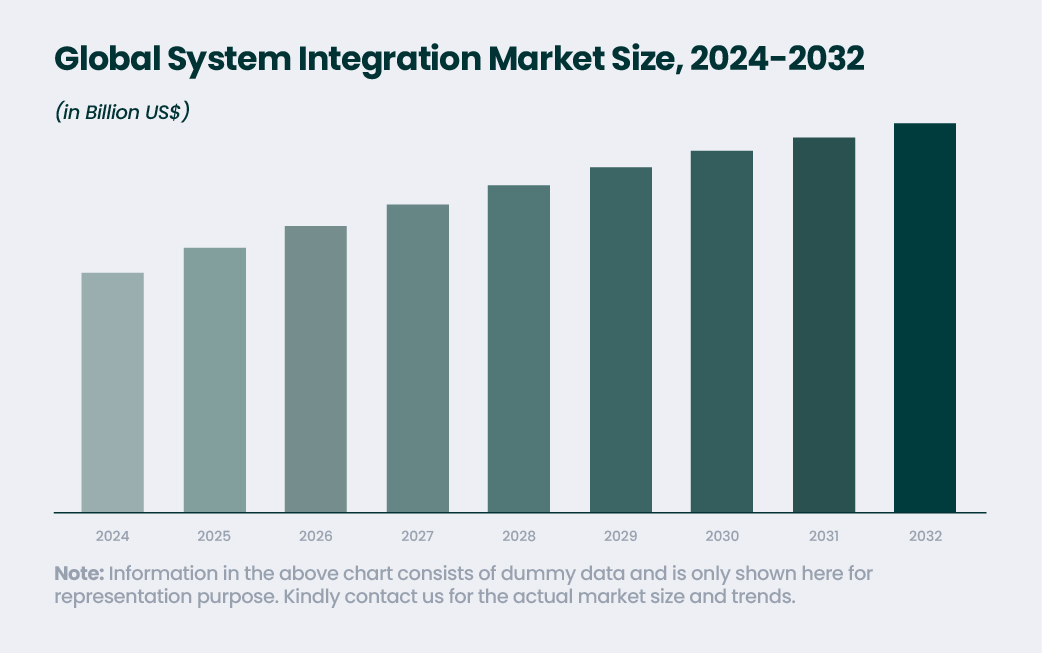
Such a situation in the market shows that system integration has become a popular option among businesses. Let’s figure out what encourages companies to integrate legacy systems with the latest technologies.
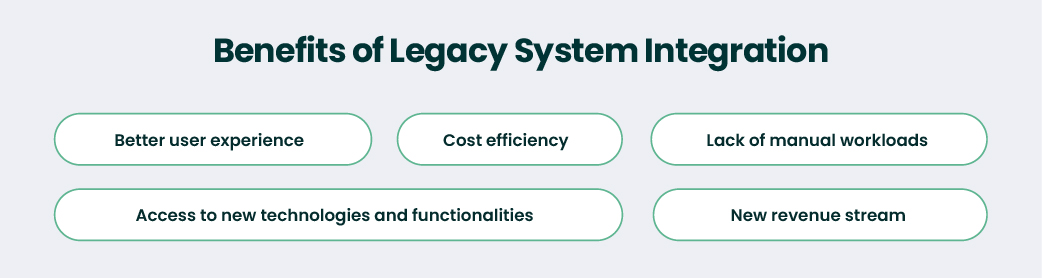
Better user experience
Integrating legacy systems with modern technologies enhances user experience. From providing users with real-time and accurate information to ensuring smoother operations, these are the points that lead to customer satisfaction.
For example, at Forbytes, we can connect your outdated inventory system with BigCommerce for a better online shopping experience. As a result, your clients will get everything they need about products and their prices. This can lead to repeat business and loyal customers. By meeting modern requirements while using your trusted legacy system, you’ll strengthen your position in the market and maintain competitiveness.
Cost efficiency
Maintaining outdated legacy systems can be costly due to the need for investment in managing old code and handling support requests, which can take a long time to resolve. Legacy system integration can ensure cost efficiency and better management of existing resources. By updating modern systems and languages, you can reduce costs on skilled developers and minimize overall application issues.
With a modernized legacy system, businesses can streamline operations, reduce manual effort, and automate data flow. As a result, they can invest saved costs into other processes.
Reduced manual workloads
With legacy system integration, you’ll decrease the amount of manual work and streamline the work of team members, especially when handling large volumes of data. Plus, your system will operate faster in real-time, reducing the likelihood of performance drops.
Higher speed and better responsiveness of your system are the results of integrating your legacy system with a modern stack. So, you’ll enhance user satisfaction and boost your business efficiency.
Access to new technologies and functionalities
An outdated tech stack limits business growth. That’s why many companies focus on cloud computing and continuous system integration. Reasonably, it’s time to update legacy software accordingly to avoid lagging behind competitors. Legacy system integration offers a way to supercharge your legacy system with modern technologies and new features, all without starting from scratch.
At Forbytes, we can re-engineer your solution to ensure it aligns with current technologies and strengthens your business competitiveness. We can help you identify changes and updates your legacy system may need to stay advanced.
New revenue stream
An outdated system can limit the potential of your business, especially in terms of creating new services and delivering more value to your target audience. Plus, legacy systems can restrain software flexibility and innovation.
With legacy system integration, you can unlock new channels for revenue generation. By modernizing your software, you’ll make it more agile and efficient, thereby enabling new revenue streams. For example, integrating with new technologies will contribute to creating more services and benefits for your customers.
How to Integrate Legacy Systems with Modern Software: Main Steps
Legacy system integration is more than just picking the right technologies to modernize software. You should prepare your team to use the updated system and plan the integration step by step. Plus, you also should ensure that integrating the legacy system aligns with your business needs. So, here’s what you should do.
- Step 1: Assess and plan: Start integrating your system with modern technologies by conducting a thorough assessment of your legacy system and developing a comprehensive integration plan. Whether you need to move to microservices or enhance your software with AI, having a clear plan is the first step toward successful legacy system integration.
- Step 2: Test integrations: Once you gain a plan for integration, test the integrations in a separate environment before deploying them to production to ensure smooth changes.
- Step 3: Optimize performance: It’s vital to identify bottlenecks and performance drops to understand how to optimize the functioning of your system.
- Step 4: Document integration processes and train your team: Keep up-to-date documentation for the modernization of your system and provide training for your team on the new integrations and tools.
- Step 5: Focus on integrations with scalability: To ensure future business growth opt for integrations with scalability in mind to further develop your system.
- Step 6: Monitor and maintain: To track the health of integrations and ensure the long-term functioning of your system, implement monitoring tools and plan for regular updates.
Schedule a free consultation to discuss the challenges you face, and we will assist with legacy system integration solutions.

Solutions and Best Practices for Integrating Legacy Systems
Now it’s high time to share solutions and best practices that you can apply to integrate your legacy system with the latest technologies and modernize it. The choice depends on your specific needs and the capacity of your software to upgrade. Here are some of them that we recommend to our clients.
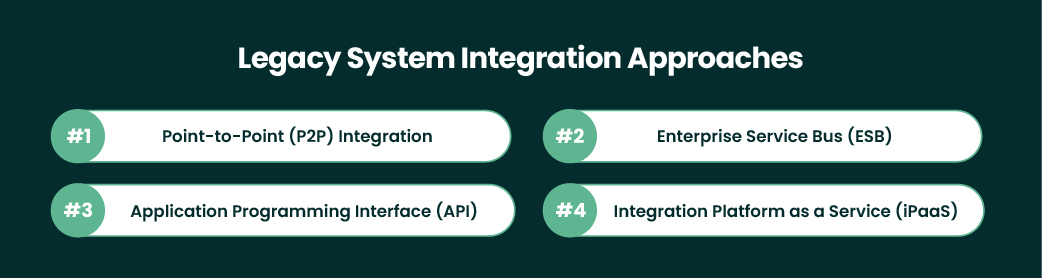
Point-to-Point (P2P) Integration
To integrate your legacy system with modern ones, you can opt for P2P integration. It connects two apps using custom code. The rationale for this approach is that it can be applied when you deal with a single integration. Or you can use it when you have two homegrown systems. The weak point of this practice is that it can’t handle multiple integrations.
Enterprise Service Bus (ESB)
ESB is the integration of multiple apps into a single ecosystem. In e-commerce, an Enterprise Service Bus links various apps like Order Management, CRM, Payment, Inventory, Customer Support, Shipping, and Analytics. For instance, the Order Management System uses the ESB to sync data with CRM for personalized customer interactions while Inventory for real-time stock updates.
Application Programming Interface (API)
API is one of the most common methods to connect technologies to each other. APIs are like messengers which ensure that apps interact efficiently. It seems that APIs and ESBs have similar functions. But API integrations bring more benefits. First, they ensure the effortless integration of hundreds of apps. Second, they optimize functionality with API gateways. Finally, APIs provide more monetization opportunities.
Integration Platform as a Service (iPaaS)
An iPaaS connects applications with varying integration capabilities using both ESBS and APIs. As a result, it enables businesses to build and manage various integrations effortlessly. This solution is particularly relevant for companies requiring numerous integrations.
Modernization
To increase scalability and reduce the cost of development, we offer to modernize your legacy system using the following strategies:
- Refactoring: We assess and conduct root-cause analysis of your legacy system to update and improve its code and structure. This solution streamlines and optimizes your app for better scalability and performance.
- Migration to microservices: If your system is built as a monolithic application and you experience scaling problems, we can migrate your solution to the microservices-based architecture. This approach offers greater flexibility, convenience, and capacity to build more manageable services that can be developed and scaled independently.
- Cloud migration: If you require a more reliable, scalable, and speedy solution, we can migrate your on-premise software to cloud infrastructure. As a result, your legacy system will work more efficiently and handle traffic spikes hassle-free. Plus, you’ll have more opportunities for developing, maintaining, and scaling your solution.
- Reengineering: We can update or redesign your legacy system to improve its usability, functionality, and performance. This ensures that your existing application meets changing business needs, tech advances, and user expectations.

Forbytes’ Expertise in Legacy System Integration
Our client, Offerta.se, is the largest service provider in Sweden, operating in 140 industries and partnering with 34,200 companies. The company has a B2B and B2C platform called Offerta, used for generating leads across more than 140 categories of professional services. Through this platform, businesses can find new clients and provide a wide range of service choices tailored to their budgets and needs.
As the platform grew, our client faced several challenges. First, they needed to develop new features and enable updates to ensure a better user experience. Second, they wanted to drive business automation and efficiency. Finally, our client needed to improve information and process flows for the internal support system and web apps.
Therefore, the company turned to Forbytes to modernize its legacy system by supercharging it with more features and capabilities. See how we approached system updating.
First, our team completely redesigned, transformed, and optimized the legacy system to ensure it meets users’ needs. Second, we implemented the right tech stack to provide quick data access for the front end without any performance drops and automated manual operations. Third, our team added new features like live chat, message templates, and checklists for providing services to enhance the user experience. Finally, we moved the system from a monolithic architecture to microservices to make it more scalable.
Final Thoughts
Legacy integration requires robust expertise and combining different approaches to get better outcomes. At Forbytes, we’ve been working for over 12 years and have numerous successful projects in e-commerce, logistics, property management, banking, and more. Your project could become our next success story in legacy system integration.
So, whether you’re integrating your system with the latest technologies or modernizing and replacing it entirely, contact us, and we’ll breathe life into your old tech with our innovative solutions.
Share:
-

-

-
Successfully copied

-


Volodymyr Yakymiv
Author
I’m thrilled to be your source of insights on this blog as a seasoned System Architect with more than 12 years of experience. My journey in the world of technology has been both exhilarating and enlightening. I hold several certifications from Microsoft, and my expertise spans across various facets of system architecture. Let’s together uncover the secrets of building robust, scalable systems in the digital age.
FAQ
How do you handle the integration between the old and new systems?
To handle the integration between the old and new systems, you should follow all these steps:
- Assess both systems to understand how they work and whether they can interact smoothly.
- Find integration points to figure out whether systems need to share information.
- Create a map data flow to see how data will move between the old and new systems.
- Choose the integration method to decide how to connect systems.
- Build integration to create the tools needed to link systems.
- Test everything to check whether the integration works.
These steps should help you smoothly integrate old and new systems.
How to integrate legacy systems?
- Point-to-Point (P2P) Integration: Connects two applications using custom code.
- Enterprise Service Bus (ESB): Integrates multiple applications into a single ecosystem.
- Application Programming Interface (API): Common method for connecting technologies. Enables efficient interaction between applications and supports hundreds of integrations.
- Integration Platform as a Service (iPaaS): Connects applications with varying integration capabilities, combining ESBs and APIs.
Modernization Strategies:
- Refactoring: Updates and improves legacy system code and structure.
- Migration to Microservices: Migrates monolithic systems to microservices architecture.
- Cloud Migration: Moves on-premise software to cloud infrastructure.
- Reengineering: Updates or redesigns legacy systems.






Let's Get in Touch




Forbytes created an app that allowed users to quickly measure themselves to be fitted for custom shirts. As a result, we could increase our speed, quality, and shirt output per week. Forbytes was dedicated to delivering a solution that accurately addressed our needs.

Forbytes’ engineers and team leads worked as part of our RnD group and were directly managed by our company directors. They were both proactive and adaptable, qualities that perfectly match our needs in our fast-growing and constantly evolving environment.

Forbytes has a strong process-oriented way of leading the company, with good respect for themselves and their managers. They made a choice not to become too big but build slowly on more qualified people, which is paying off.

Niklas Hammar
COO & Business
Development at Offerta.se

Our e-commerce site saw online inquiries and orders rise after working with Forbytes. The team used top-notch expertise to inform their suggestions and improvements. Constant communication, quick responses, and prompt delivery made for a smooth and enjoyable collaboration.

The Forbytes team was very professional and demonstrated a great understanding of the business aspects. All tasks were completed above expectations. Their experts were always available, and we never needed to wait for a response or a suggested solution.