




Mobile users check their devices around 144 times daily. That means you have more than 140 chances per day to attract their attention. Of course, provided that you offer relevant services to the relevant audience. Sounds promising and challenging at the same time, right?
When it comes to real estate businesses, mobile app development seems an optional move. You already have a website, a loyal audience, and a huge amount of work done under your belt. However, in 2026, when app users generate 3.5x to 7x more revenue than web users, ignoring mobile apps means leaving a significant share of revenue untapped.
Today, we will discuss real estate app development through the eyes of business owners and strategists. Keep reading to explore the industry situation, reasons to invest in mobile solutions, real estate mobile application types, and some inspiring examples of real estate companies that conquer the market.
What’s Waiting for Real Estate App Investors? Key Market Insights
2026 seems to be a perfect year for investing in real estate app development. On the one hand, you can learn from the experience of companies that started earlier. On the other hand, there’s still an opportunity to establish a strong presence in the growing real estate app market.
Every day, some business becomes a proud owner of a real estate software solution. In 2024, the total value of real estate software solutions was $11.2 billion. In 7 years, it’s expected to almost double, reaching $22.5 billion.
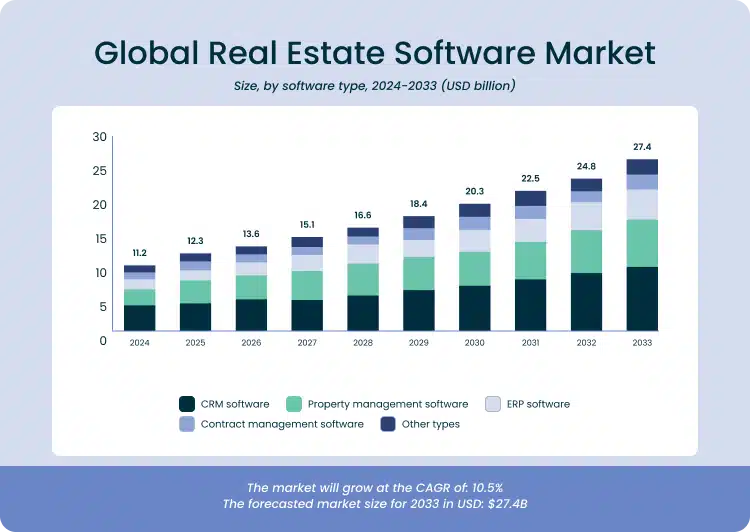
Thus, the real estate sector shows no signs of slowing down. And there still exist a lot of problems that real estate application development can solve. These include:
- Fragmented property information. Users often struggle to find comprehensive listings in one place.
- Inefficient communication. Buyers, sellers, and agents face delays due to scattered messaging channels.
- Complex paperwork and transactions. Handling contracts, financial transactions, and approvals is often slow and error-prone.
- Limited personalization. Most platforms offer generic recommendations instead of property suggestions based on user preferences.
- Poor user experience on mobile. Many real estate services are not fully optimized for smartphones, leading to frustration.
- Difficulty comparing options. Users lack intuitive tools to evaluate properties, neighborhoods, or financing side by side.
A well-designed mobile app can address these pain points, streamlining the process and delivering a smoother, more engaging experience for all parties involved. Get in touch with our team to receive a detailed consultation on the features of your future mobile app that will best solve your customer pains.
Real Estate in Your Pocket: Why Leading Businesses Invest in App Development
Now you know that real estate mobile applications make clients’ lives easier. And what about businesses? In fact, investing in real estate mobile app development gives companies a number of benefits, too. Let’s go through them:
1. Boosted customer engagement
Since the phone is always close to the client, creating a mobile application gives you multiple opportunities to stay connected with them and continuously engage them.
Push notifications, chatbots, and gamification elements of the real estate app development solutions all help literally hold the client’s attention. Combined with effective marketing, they drive clear business growth.
2. Leading market positions
While your competitors are still stuck at the level of basic websites, you have a great opportunity to take a leading position by building an innovative application. Just five years ago, implementing AI in real estate application development sounded out of reach.
Today, every second app includes AI or virtual reality technologies that help personalize the user experience, making the customer journey easier for them and delivering higher conversions for you.
3. Budget recoup
In addition to all these great benefits, you also have the chance to effectively recoup the investment in the real estate app development solutions.
You can use different monetization strategies for your app, such as adding premium features, subscriptions, early paid access, and others. In this way, you will earn money while delivering an excellent user experience to property buyers.
4. Simplified operations
Real estate application development simplifies the behind-the-scenes work of your business, including document management. It provides a single and secure place to store and manage different document types, significantly saving your team’s time and resources.
5. Improved lead management
Unlike traditional methods, tracking user activity in applications allows you to more accurately monitor potential customers and leads, nurture them in a personalized way using smart technologies, and ultimately achieve more closed deals.
Want to Experience These Benefits in Practice?
Get in touch with our team, and we’ll help you develop the best plan for your mobile application.

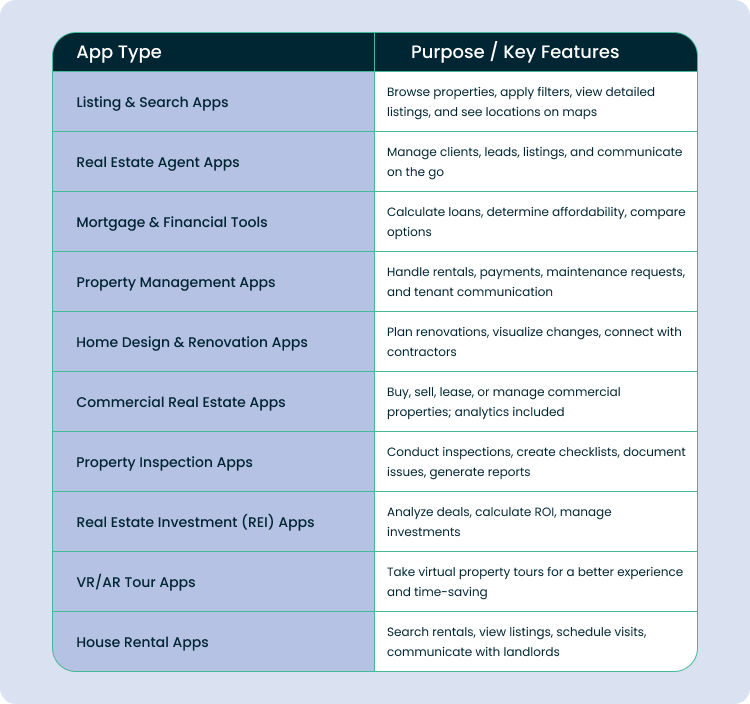
10 Main Types of Real Estate Applications
Before jumping into real estate app development, it helps to step back and ask a simple question: What exactly should your app do? Most successful real estate apps don’t try to do everything at once. Real estate application development should start with a clear core use case and expand over time. For example:
- A listing app can evolve into a marketplace
- A property management tool can add financial tracking
- A rental app may introduce virtual property tours
That’s why your best strategy is to choose the key purpose and then scale your app step-by-step. Here are the main types of real estate mobile applications and core functions you can focus on:
What Real Estate App Features to Prioritize and Which Ones Are Optional?
Now comes the part everyone is usually excited about and slightly overwhelmed by. Features of the real estate app development solutions. It’s tempting to pack everything into your app from day one. But the smartest products don’t start big. They start useful and then grow.
A good way to think about features is in three layers:
- What you must have
- What makes you competitive
- What makes you stand out
Let’s break it down.
Basic features: real estate mobile app foundation
This is your app’s “it just works” layer. Nothing fancy, but absolutely essential. These features of real estate app development solutions cover the core user journey: search → explore → evaluate → contact.
Skip any of these, and the experience starts to feel incomplete. Like a house with no front door. Here are some examples of the basic real estate app features:

Nice-to-have features: your competitive edge
This is where your app stops being just functional and starts being convenient. These features reduce friction and decision time.
Instead of users jumping between tools, tabs, and platforms, your app becomes a one-stop decision hub. And that’s exactly what keeps them coming back. Let’s look at the nice-to-have features in detail:

Custom features: your differentiator
Now we’re entering the territory where real estate app development solutions become more than tools. They become branded products. This layer is where real competitive advantage lives.
At this point, you’re not just helping users find properties — you’re helping them get valuable insights and make smarter decisions faster. These are the examples of the custom features worth your attention:
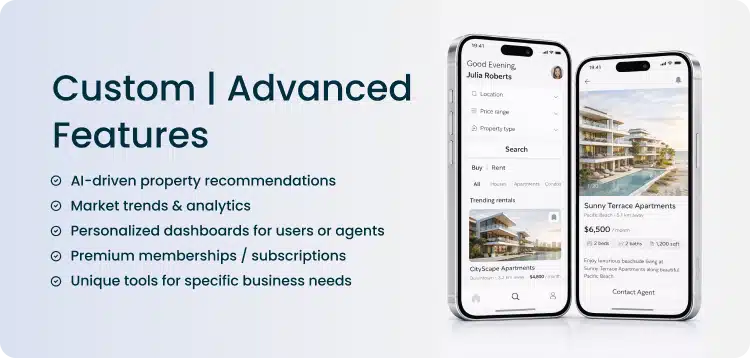
So, when building a real estate mobile app, start with the essentials that make your solution genuinely useful. Layer in features that simplify decisions and save time. Then, once you understand your users, invest in capabilities that feel almost tailor-made for them.
The goal isn’t to build the most complex app. It’s to build something people don’t want to close.
If you’re not sure which features make sense for your specific case, it’s worth getting a second opinion. The team at Forbytes can help you shape a feature set that aligns with your business goals, user needs, and budget. Contact us to get a feature breakdown and an estimation.
How Much Will Real Estate App Development Cost You? Factors to Consider
The total cost of your real estate mobile application depends on many factors. These include:
- App functionality
- Custom design
- Technology stack
- System integrations
- Team composition
- App maintenance and updates, etc.
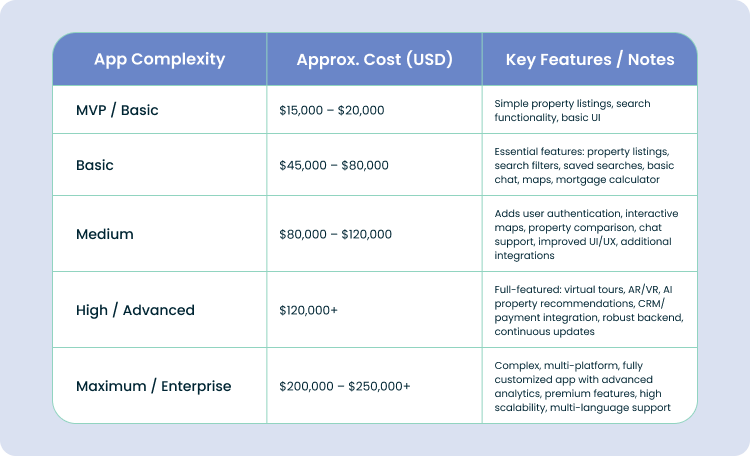
The more work required on your solution, the higher the cost. This way, simple real estate app development solutions with basic features may cost you around $15,000. Meanwhile, a feature-rich, advanced app can take even $120,000+.
Below, you can see the average price breakdown for real estate applications:
However, it may happen that your app type and the chosen features are out of your budget. Then, look at the tips that our real estate experts prepared for such cases:
- Start with MVP. MVP development allows you to test the viability of your real estate app idea and the actual need in your application among the target audience. If the results are promising, then you will move to full-scale app creation.
- Outsource real estate mobile app development. Partnering with offshore or nearshore teams significantly cuts project costs. You get access to high-level technical expertise for the lower price, maintaining your app quality.
- Use cross-platform frameworks. If you need an application for several platforms, frameworks like Flutter or React Native can reduce the development time and be much more efficient than native development.
How to Earn More than You’ve Invested in Real Estate Application Development
Investing your budget into real estate apps can and should bring you money back. And even more than was invested. You have several options to make it possible:
- In-app fees. When completing a transaction via your app, users will be charged some part of the property’s sale or rental value. Usually, the percentage is low and acceptable by users in exchange for the security and speed of the transaction.
- Subscription-based model. Real estate professionals can offer some advanced features or exclusive services in the paid subscription model. This can include early listing access, AI-powered features, virtual tours, and others.
- In-app ads. When scrolling through property listings, your app users will see targeted ads for the services related to the real estate industry. For example, ads of the moving companies, local businesses, mortgage lenders, etc.
- Affiliate marketing. Another way to earn from the real estate app development is to cooperate with relevant businesses. If app users engage with the partners, real estate agents earn a commission.
- Lead-based model. Similarly to the previous option, you cooperate with businesses, charging a fee for each lead. Once a lead makes a successful transaction on your partner’s website, you get remuneration.
To choose the best monetization model for real estate app development solutions, conduct real estate market and audience research. Based on the data, you will find out the options that work best in your real estate domain.
What’s more, there exist rules according to which each monetization model should be implemented. If you choose in-app ads, then you should know about pop-up limits so as not to overwhelm your audience with annoying content.
Or, when you opt for a subscription-based model, plan out the free trial effectively. By doing so, you will present the value users will get from paying for extra features.
Forbytes can help choose, test, and implement any modernization method effectively. Get in touch with our team to receive a free analysis of your app and a proposal for the best monetization strategy.
Examples of Businesses that Created Successful Real Estate Apps
Looking for some inspiration before starting your real estate app development project? Hopefully, there are many examples of real estate apps that have won the market. Here are the top 5 US-based app cases:
- Realtor.com. Not just listings, but speed. The app is known for near-real-time updates sourced directly from MLS databases.
- Homesnap. Built for instant gratification. Snap a photo of a house and unlock property details within seconds. It turns curiosity into data.
- Zillow. The data heavyweight. Zillow doesn’t just list homes, it predicts, estimates, and visualizes market trends.
- Redfin. A brokerage with tech DNA. Redfin combines app-based search with salaried agents and lower commission models.
- Apartments.com. Focuses heavily on user experience for renters, with layered filters, 3D tours, and neighborhood insights.
Want Your Solution to Be on the List of Top-Rated Apps?
Book a call to get a plan for your real estate mobile app project from our industry experts. No obligations, no strings attached.
Build Your Real Estate App with Forbytes
After reading this article, you know everything about real estate mobile development. The next step is to plan out the project effectively to minimize risks, protect your investment, and get the best ROI. This is where our real estate app developers can help.
Forbytes has 15+ years of experience in custom software development. Our deep industry knowledge is combined with technical expertise and a risk-reduction approach. Contact us for the initial consultation on your future project and get a prompt response from our real estate experts.
Share:
-

-

-
Successfully copied

-


Anzhelika Danielkievych
Author
My mission at Forbytes is to help our IT experts share complex information in plain language. The articles we produce reflect our expertise and help readers keep pace with the market trends and insights. We strive to educate, inspire, and empower our audience through compelling content that tackles the intricacies of the IT world and makes it accessible to all.
FAQ
How long does real estate mobile app development take?
Your timeline will depend on many factors, similar to the project costs. The more features you need to create and the fewer people you have on board, the longer your development process will last.This way, the basic application can take between 3 and 6 months to create. In our practice, real estate businesses that opt for mid-level apps spend 6-9 months building them. Lastly, advanced solutions may take 1 year or more to implement.Get in touch with Forbytes consultants to receive a free project estimate for your unique case.
What tech stack is used for real estate application development?
The precise tech stack varies from application to application and totally depends on your app’s purpose and features. We may give you a rough example of the tech combination that can be used in real estate mobile app development. It involves:
- Backend: Django, Node.js, Laravel;
- Frontend: Kotlin (Android), React Native, Swift (iOS), Flutter;
- Database: Firebase, PostgreSQL, MySQL;
- APIs & integrations: Stripe for payment gateways, MLS (Multiple Listing Service), Twilio for messaging, Google Maps API.
What are the reasons to build real estate app development solutions?
You expand your audience, boost brand reputation, and get more control over user experience. By creating a mobile application, you strengthen the connection between you and your clients, increasing the time they spend on your services.
What aspects affect the cost of real estate mobile app development?
There are numerous aspects shaping the cost of your application.These include app’s complexity (how many features you need and how advanced they are); UI/UX design complexity (whether you use the templates or create custom designs from scratch); mobile app architecture (whether you build for one or multiple platforms and how many integrations are needed), and more.Our real estate development team can calculate the precise cost of your application. Contact us to provide app details, such as required features, timeline, preferable budget, etc.
What future technology trends to expect in real estate app development?
The real estate app development market will keep growing, strengthened by the following trends:
- AI-driven personalization. Instead of generic and filter-based listings, users will use highly personalized property recommendations that are based on their app behavior, personal data, preferences, etc.
- Immersive virtual property tours. Interactive 360° walkthroughs will ensure users feel like they are visiting the property. Highly detailed overviews will help make the right purchase decision, cutting the need for physical visits.
- Predictive analytics. Artificial intelligence and big data in real estate will help buyers, sellers, and agents anticipate market shifts, including price trends, neighborhood growth predictions, risk assessments, etc.
- Location intelligence. Users will explore lifestyles, not just real estate listings. Mapping will go beyond pins and involve dynamic walkability scores, crime and school data overlays, real-time transit and noise analysis, and more.






Let's Get in Touch




Forbytes created an app that allowed users to quickly measure themselves to be fitted for custom shirts. As a result, we could increase our speed, quality, and shirt output per week. Forbytes was dedicated to delivering a solution that accurately addressed our needs.

Forbytes’ engineers and team leads worked as part of our RnD group and were directly managed by our company directors. They were both proactive and adaptable, qualities that perfectly match our needs in our fast-growing and constantly evolving environment.

Forbytes has a strong process-oriented way of leading the company, with good respect for themselves and their managers. They made a choice not to become too big but build slowly on more qualified people, which is paying off.

Niklas Hammar
COO & Business
Development at Offerta.se

Our e-commerce site saw online inquiries and orders rise after working with Forbytes. The team used top-notch expertise to inform their suggestions and improvements. Constant communication, quick responses, and prompt delivery made for a smooth and enjoyable collaboration.

The Forbytes team was very professional and demonstrated a great understanding of the business aspects. All tasks were completed above expectations. Their experts were always available, and we never needed to wait for a response or a suggested solution.

Modern commerce is not a linear movement. Before buying from your marketplace, customers use multiple channels and interaction points, including social media, e-commerce platforms, mobile applications, ads, and more. According to Capital One Shopping Research, 91% of consumers engage with e-commerce businesses this way, proving the rising demand for omnichannel experiences in retail.
Similarly, clients expect an integrated experience after purchasing. They require your marketplace to show them logistics info, payment status, inventory updates, etc., all in one system. With marketplace integrations, you can turn your e-commerce platform into a convenient, all-in-one stop for the client, driving higher customer satisfaction and boosting sales.
In this article, we will discuss the importance of marketplace integration, guide you through the main types and examples, and explain how to link two or more systems in a consistent and stress-free way.
Key Takeaways
- Customers gain full visibility of orders, inventory, and payments, making the buying process seamless and transparent.
- Merchants benefit from centralized dashboards that simplify inventory management, sales tracking, marketing, and customer support across multiple sales channels.
- Automation reduces manual work, prevents inventory discrepancies, and enables your marketplace to scale efficiently.
Interested in Marketplace Integration Audit?
Let our experts review your marketplace and find out what integrations you lack for higher sales.
Marketplace Integration Explained: Why It’s Not Only About Connecting Software
Marketplace integration means adding third-party software to your main marketplace platform. However, this process is not only about the technical side. By connecting various systems, you can solve real operational challenges and expand buyer and seller audiences.
Data sync plays a vital role in any marketplace integration. Instead of switching between systems manually, users get access to all product data in one place, which increases their business capabilities and boosts customer retention.
In what way? Customers receive 100% visibility of order details and get enough flexibility for decision-making. They don’t have to reach out to the support team to clarify the order status or go to the logistics company’s site for order tracking. Instead, a user just logs into the personal cabinet and feels as if they are in a physical store where purchases are made end-to-end.
As for your merchant audience, they get more operational instruments thanks to marketplace integrations. Through the connected channels, your merchant partners access consolidated performance and inventory data, manage customer inquiries, centralize their marketing efforts, analyze e-commerce metrics, and more.
Using a single dashboard, they get a 360-degree view of their online shop. As a result, they spend less manual effort on collecting data and have more time for using this data practically.
So, why do marketplace integrations matter? By connecting your marketplace to different systems, you allow customers to actually “own” the purchase process. Meanwhile, your merchants also benefit from automation and operational efficiency that come with marketplace integrations.
Altogether, by benefiting these audiences, you grow the popularity of your marketplace and increase profits accordingly.
Why Do Marketplaces Need Integrations? Key Benefits to Explore
Not all marketplace integrations are equal. The choice of the solution depends on your needs and the expected project results. In this section, we explain why major marketplaces invest so much of their budget into connecting their software to third-party solutions. The key integration benefits include:
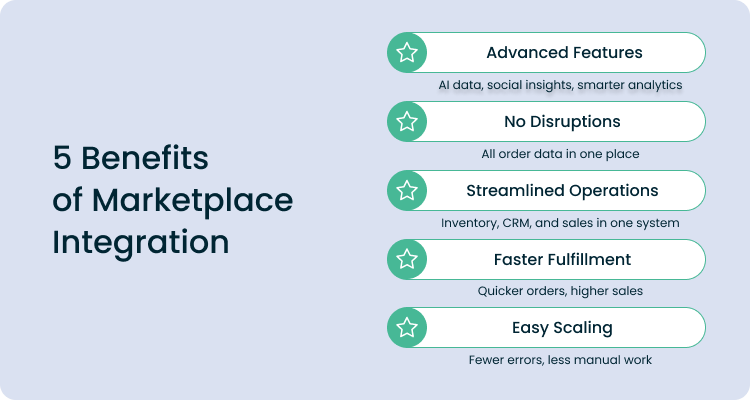
- New features and functionalities for marketplace users. Marketplace integration opens the door to the opportunities that other systems offer. For example, by connecting your marketplace to AI-powered software, you get the chance to increase conversion rates by up to 15%.
- No disruption to marketplace operations. Merchants and customers no longer need to switch systems to get a complete picture of each order. All the data is displayed in one place. This saves time, effort, and around 20% of the operational budget.
- Streamlined processes and business connectivity. Marketplace integrations centralize all retail operations under one roof. Merchants can manage their inventory sales, CRM, and analytics using a single system. And as a result of integrated analytics, 72 % of organizations highlight improved decision‑making capabilities and, thereby, wider market opportunities.
- Faster order fulfillment and higher sales. As numbers show, AI‑optimized logistics can cut delivery times by 25% and boost repeat purchases by 15%. The faster your merchant completes the order, the more they earn. The convenience you give your merchants affects the popularity of your marketplace and your profits accordingly.
- Error prevention and scaling without complexity. Without a powerful marketplace integration, e-commerce teams have to manually fill in data. With integrations, you reduce manual data entry, allowing merchants to do more with less and cut errors. For example, by connecting your marketplace to automated warehouse systems, you can increase the fulfillment accuracy by up to 70%.
Want to implement the right integration and test all these benefits in practice? Contact us, and let our experts analyze your needs, choose the solution, and connect it efficiently.
Must-Have Integrations for Online Marketplaces: Types & Examples
Now that you know how important it is to add new functionality to your marketplace, we present you with the top 6 must-have integrations. The final choice of solutions depends on your goals, marketplace model, technical requirements, and system compatibility. Consider these critical categories to make your marketplace powerful:
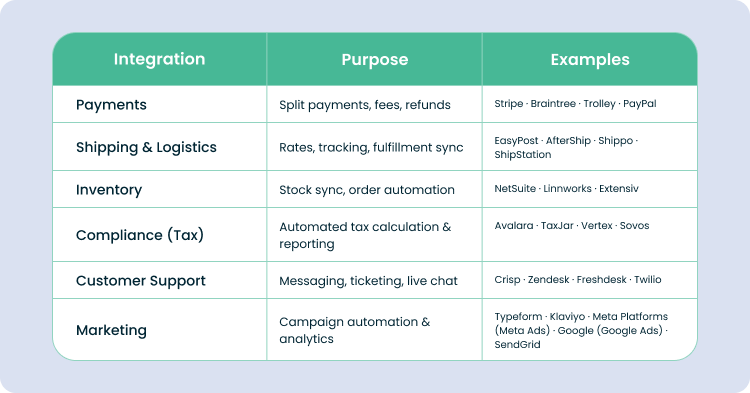
Payment marketplace integrations
Payment integration designed for marketplaces should offer multi-vendor payment features.
Unlike simple e-commerce payments, marketplace payment solutions should also automatically deduct fees, support refunds, ensure financial compliance, and allow for split payments.
Popular payment apps for marketplaces: Stripe, Braintree, Trolley, PayPal.
Shipping and logistics integrations
Since online shoppers expect real-time access to data and fast, reliable delivery, you will need to connect your marketplace platform with a shipping management system.
Shipping marketplace integrations are used to display real-time shipping rates at checkout, track order shipments without leaving the platform, and automate order processing for all parties involved.
Popular shipping & logistics apps for marketplaces: EasyPost, AfterShip, Shippo, ShipStation.
Inventory management integrations
Multi-vendor and multi-location marketplaces make it harder to manage inventory levels. Sellers require real-time inventory data to prevent overselling. Marketplace teams may use the same data to coordinate stock levels across vendors, which is impossible to do without integrations.
By connecting your marketplace to inventory management software, you will keep your inventory data in sync, cut manual work, and prevent inventory management errors.
Popular inventory management apps for marketplaces: NetSuite, Linnworks, Extensiv.
Compliance integrations
Compliance marketplace integration acts as the “legal shield” for your platform. They automate the massive headache of staying on the right side of the law.
Without seamless integration of such tools, your team would be buried in manual ID checks and complex tax spreadsheets. By automating compliance processes, you ensure your platform stays protected from fraud and hefty government fines.
Popular compliance management apps for marketplaces: Avalara, TaxJar, Vertex, Sovos.
Customer support integrations
Customer support integrations turn your marketplace into a professional, unified service hub. In a multi-vendor environment, support is notoriously tricky. You have to bridge the gap between the buyer, the seller, and your own platform’s support team.
Instead of jumping between dozens of seller portals or email threads, these marketplace integrations pull every conversation into a single dashboard. Crucially, they link each ticket to real-time order data, allowing agents to see exactly what was bought, when it was shipped, and who the vendor is, without asking the customer for a single order number.
Popular customer support solutions for marketplaces: Crisp, Zendesk, Freshdesk, Twilio.
Marketing integrations
Marketing integrations are the “growth engine” of your marketplace. While your merchant partners sell products on your platform, these tools ensure that the right customers actually find them.
By enabling this marketing integration, you can use real-time data (like what a user browsed or what they left in their cart) to trigger personalized emails, SMS alerts, or social media ads. This automation keeps your marketplace “top of mind” for merchant partners without requiring a huge manual marketing team.
Popular marketing integrations for marketplaces: Typeform, Klaviyo, Meta Ads, Google Ads, SendGrid.
6 Steps to Start with Marketplace Integrations in a Stress-Free Way
Below, we suggest a 6-step checklist to plan your integration process efficiently. If you get stuck at any of these steps, contact Forbytes. Whether you are at the beginning of your integration journey or need post-integration support, we will gladly help.
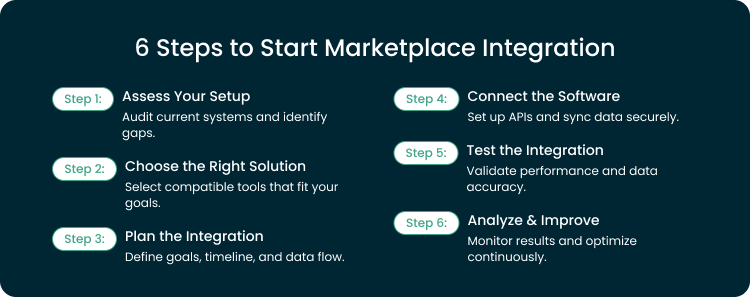
1. Assess your current setup
Start your marketplace integration process by analyzing your current infrastructure. What tools have you already set up, and which ones do you lack? Do you have an ERP system, payment gateway, CRM system, and CMS software connected to your marketplace? What solutions do you still need for a more consistent merchant experience and higher customer trust?
For the preferred tools, analyze the technical limitations and potential data exchange logic to make the audit practical and realistic. By documenting essential data, you will be ready for the potential challenges and quickly solve them.
2. Pick the best solution to add
Find the best solution for your marketplace integration. Look at what the competitors offer on their marketplaces. Check the solution for compatibility and performance. Figure out what type of connection this software allows for.
Study the features offered in the solution. How much automation is here? Is AI implemented under the hood? The chosen tool should perfectly align with your expectations, including the implementation cost, business impact, and long-term value.
3. Plan out the marketplace integration
Planning out the system integration involves defining goals and KPIs, breaking the project down into milestones, and defining timelines and responsible teams.
After the general plan is ready, you need to dive into the technical side of the project. The technical team will map the data flow between the two solutions, prepare the data formatting logic and rules, and ensure that the strategy is well-supported by both systems.
4. Connect the software
After planning, move to the step-by-step implementation. Your technical team will be responsible for setting up e-commerce API credentials, authorizing marketplace accounts, and ensuring secure data sync.
When your marketplace integrations are structured, it reduces errors and the risks of data inconsistencies.
5. Perform testing
Test your software integration before going live. Import test data and make sure it is displayed correctly. Both automated and manual testing are required for proper integration performance.
An important part of the testing is simulating merchant and customer behavior on your marketplace. For this, you can involve real website users or entrust the process to your QA team.
6. Analyze and improve the integration
That’s the moment when your marketplace integration goes live. The work does not stop there. Likely, your integration will require some refinement. To figure out how the connection performs, allow for user feedback.
By studying reviews and performing regular system audits, you will make sure that the integration brings long-term value to your business.
Need Help with Marketplace Integrations?
We’re here to discuss your challenges and help you achieve your goals.
Make Your Marketplace More Effective with Forbytes
As you can see, modern commerce requires businesses to consolidate their effort, data, and tools into a unified IT infrastructure. As each system operates under its unique rules, without integration, it’s hard to get a consistent view of a business.
In this article, we covered everything you need to know about marketplace integration to prepare your team for the positive changes. The next step is implementing these changes technically.
If you are looking for experts in e-commerce system integrations, you are in the right place. Forbytes has 15+ years of experience in software engineering. Retail & e-commerce are at the heart of what we have been doing during that time.
With numerous clients in this industry, we’ve dealt with nearly every challenge that retailers typically face and have an efficient, budget-friendly, and intuitive solution for your goals. Reach out to us to get a free consultation on your integration needs.
Share:
-
-
-
Successfully copied
-
Anzhelika Danielkievych
Author
My mission at Forbytes is to help our IT experts share complex information in plain language. The articles we produce reflect our expertise and help readers keep pace with the market trends and insights. We strive to educate, inspire, and empower our audience through compelling content that tackles the intricacies of the IT world and makes it accessible to all.
FAQ
What's the difference between marketplace integration and integration marketplace?
Marketplace integration lies in connecting your marketplace sales channel to external, third-party services. It’s done to automate order management across operations, including marketing, inventory, logistics, etc. For example, an Amazon merchant can link their marketplace store with a PIM system.Integration marketplace means a totally different thing. It’s like a store where integrations are presented, and you can choose the one needed. For instance, the HubSpot App Marketplace offers dozens of useful integrations to automate CRM.
What are the types of marketplace integrations?
We can outline the most common marketplace integration types:
- Third-party plug-ins. These are additional software components that extend the functionality and features of the core solution.
- API integrations. Application programming interfaces are built to exchange data and perform joint functions between two or more systems.
- Middleware integrations. This is the software layer that sits between multiple platforms, synchronizes data, and ensures data flows without altering the core apps.
Can you help me integrate a custom solution into my marketplace?
Absolutely. Our team can connect systems to your marketplace or multiple marketplaces, whether it’s through APIs, middleware, or plug-ins. We’ll make sure everything talks to each other smoothly so your data stays up to date and you face no operational complexity.Contact us to get started, and our team will guide you step by step to make the integration seamless and hassle-free.
Let's Get in Touch
Forbytes created an app that allowed users to quickly measure themselves to be fitted for custom shirts. As a result, we could increase our speed, quality, and shirt output per week. Forbytes was dedicated to delivering a solution that accurately addressed our needs.
Forbytes’ engineers and team leads worked as part of our RnD group and were directly managed by our company directors. They were both proactive and adaptable, qualities that perfectly match our needs in our fast-growing and constantly evolving environment.
Forbytes has a strong process-oriented way of leading the company, with good respect for themselves and their managers. They made a choice not to become too big but build slowly on more qualified people, which is paying off.
Niklas Hammar
COO & Business
Development at Offerta.se
Our e-commerce site saw online inquiries and orders rise after working with Forbytes. The team used top-notch expertise to inform their suggestions and improvements. Constant communication, quick responses, and prompt delivery made for a smooth and enjoyable collaboration.
The Forbytes team was very professional and demonstrated a great understanding of the business aspects. All tasks were completed above expectations. Their experts were always available, and we never needed to wait for a response or a suggested solution.
Running an e-commerce business in 2026 is a lot like running a marathon. Sure, the starting sprint of attracting customers is exciting. But the real challenge lies in retaining them and staying the course.
With growing customer demands, shifting behaviors, and tougher competition, it can sometimes feel like there’s always a new hurdle to overcome.
But just like in a marathon, the right strategy can make all the difference. Think of e-commerce best practices as your game plan. They help you pace yourself, stay focused, and tackle emerging obstacles.
Whether it’s using cutting-edge technology, creating unforgettable shopping experiences, or building trust with your audience, these strategies keep you moving forward.
So, how do you go the distance and win customers in 2025? Let’s explore the e-commerce best practices to cross that finish line ahead of the competition and grow your audience.
E-Commerce Customer Profile: Behaviors and Preferences
To attract e-commerce customers, you first need to understand them. Who are they? What do they expect? Let’s figure it out step by step.
- Today’s customers need to feel special. They love when brands attract their attention by offering tailored recommendations based on their habits. Did you know that 80% of people are more likely to buy when their shopping experience feels personal?
- Shoppers don’t stick to one device. They might browse on their phones during lunch and finalize their cart on a desktop later. In fact, 76% of adults shop on their smartphones, while 69% also use desktops or laptops.
- Shoppers value quick and easy experiences. A clunky website or complicated checkout can result in an instant dealbreaker. Also, 48% of shoppers can abandon carts when they find out unexpected fees, like shipping and taxes.
- Discounts, promo codes, Black Friday… they’re irresistible. Over 95% of Americans and 86% of British have used an online coupon at least once.
Now that you know what customers value most, it’s time to focus on e-commerce best practices that will make your online store their go-to choice.
Ready to Grow Your Online Store?
Forbytes brings you proven e-commerce strategies to the next level
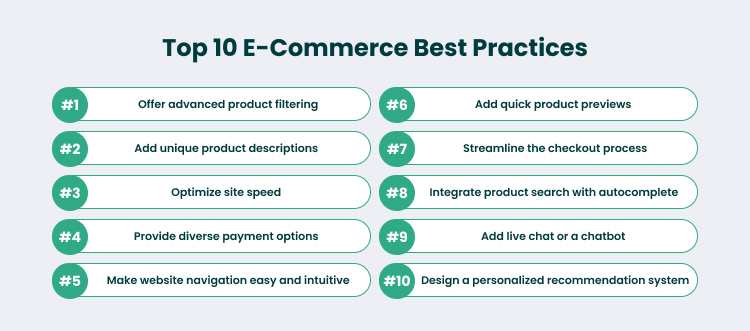
Top 10 E-commerce Best Practices to Boost Your Sales
At Forbytes, we always help our clients adopt e-commerce best practices to fuel their online stores with extra capabilities. Here are the top strategies for you to win the audience and boost your sales.
1. Add autocomplete to your store for better search
Typos happen all the time: 1 in 10 search queries online are misspelled. When customers can’t find what they’re looking for because of a small error, they’re likely to leave.
Search auto-complete minimizes the impact of typos and helps customers discover products faster. Yet, many e-commerce sites still don’t support this feature or fail to show relevant results for mistyped queries.
On Amazon, shoppers who use on-site search have a 12.29% conversion rate compared to just 2.17% for those who don’t. That’s a 6x higher chance of converting a search user into a buyer.
2. Help customers find relevant products faster
Some customers visit your online store knowing exactly what they want. But others? They’re just browsing. They want to see what you’ve got. That’s where such an e-commerce best practice as product filters comes in.
Product filters help organize your products so visitors can quickly find what they’re interested in. Consider what matters to your customers and make filters match their needs.
Remember, product filters are not just UI elements. They rely on solid data structure, search infrastructure, and performance optimization behind the scenes.
Here is a brief overview of the implementation perspective, so you understand what essential layers you need to focus on:
- Structure product data for filtering. Store parameters as standardized attributes, not free text. Define mandatory attributes per category and enforce validation during product uploads.
- Run filtering on a search index, not your database. For multi-filter selection, faceted search engines are the best option to use.
- Precompute filter facets. Generate filter combinations during indexing instead of calculating them in real time. It will give you an opportunity to keep response times stable for large catalogs.
- Make filtering seamless in the UI. Few simple rules: apply filters without page reload, keep selections visible, and optimize interactions for mobile users.
- Cache popular filter combinations. Have you noticed some common combinations? Cache those paths at the API or CDN level to reduce load and keep filtering fast during peak traffic.
3. Performance first: fix site speed
According to Google, 53% of visits are likely to be abandoned if they take more than 3 seconds to load. For an e-commerce website of any size, this leads to a loss.
What can you do about the page load time?
First, run a website store through the PageSpeed Insights tool. If the score is below 90 or not in the green zone, you need to consider the next tips to speed things up:
- Use server-side caching, optimize database queries, and consider cloud migration;
- Remove unused plugins and libraries, combine assets, and avoid loading scripts on pages where they’re not needed;
- Minify CSS/JS/HTML and enable compression so browsers download smaller files;
- Optimize image sizes, serve compressed, modern image formats, and lazy-load offscreen website images;
- Prioritize above-the-fold content so users can interact while the rest loads;
- New features often slow sites down again, so speed checks should become routine.
4.Turn product pages into decision engines
According to the Nielsen Group, on a full Amazon page, people spend only 18% of their time looking at photos. The rest is spent reading the text.

Source: TradeMax
So, if product page descriptions on your e-commerce website aren’t optimized with relevant keywords and meta tags, you’re missing organic traffic and maybe even wasting money.
The good news? Most competitors just copy and paste descriptions. That’s why this best e-commerce practice gives you the perfect chance to stand out.
If you want to achieve the best results, you can run A/B tests on structure, length, and benefit positioning to measure impact on conversion and basket size.
Pro Tip: Use Forbytes’ AI Assistant
You don’t have to stress over crafting unique product descriptions – we’ve got you covered.
Forbytes has created an AI Assistant to make life easier for e-commerce businesses. It can handle content creation, feedback analysis, and even high-quality image processing of a product.
Contact our team to get a free demo and see how it fits into your current e-commerce operations.

5. Design a personalized recommendation system
A solid personalized recommendation system is all about suggesting relevant categories and products that match what customers already plan to buy. Here’s how recommendations can work for your store:
- Cross-selling: Suggest items that complement their online shopping (e.g., a wireless mouse for a new laptop).
- Upselling: Offer premium upgrades (e.g., a higher-spec software version).
- Add-Ons: Introduce extras that may capture the user’s attention (e.g., extra pizza toppings).
Recommendations tailored to preferences and purchase history make online shopping more convenient and enjoyable.
With software like this, you can customize messages, offer discounts, and tap into impulse buying to drive results.
6. Make your e-commerce website easy to navigate
A confusing e-commerce website design costs you customers. If users can’t find what they’re looking for in seconds, they go to a competitor. That’s why simple, user-friendly navigation is a must.
- Start with a clear structure. Organize your e-commerce website so it’s easy for users to understand. Think of it like a hierarchy: Home page → Categories → Subcategories → Product catalog.
- Build a clear site structure: Every parent page should link to its relevant subcategories and product categories. Subpages should also link back to their parent page.
- Use intuitive labels: Stick with simple, descriptive names for your menus and links so users know where they’re headed.
Pro Tip: Responsive design with visual cues, like breadcrumbs or a search bar, can simplify navigation even more!
7. Let online customers preview products
Clicking on every item just to see the product detail page can feel like a chore, especially on mobile devices.
That’s where a quick preview can make all the difference. This feature lets online shoppers check out product details and compare items without leaving the main category page. No need to open a million tabs or keep hitting back. It’s faster, easier, and keeps the shopping experience smooth.
With a quick preview, customers can:
- See product images up close.
- Read key details like price, size, or color options.
- Decide faster without losing their place.
8. Add live chat or a chatbot, be available round the clock
With chatbots, your business is available 24/7. They provide users with instant support without the high cost of a round-the-clock team. They are also highly efficient, handling multiple customer inquiries at once. This saves time and ensures quick responses.

Source: GardenStore
9. Improve your checkout flow
18% of customers say that slow or complicated checkout is the reason they abandon their carts.
A convenient checkout process should be quick, simple, focused, and flexible. Customers should get through it easily.
Here are a few checkpoints that will make the checkout process more accessible:
- Remove the navigation bar and footer during checkout;
- Enable guest checkout. You can lose 19% of customers by forcing them to create an account;
- Cut the number of various elements, like form fields, to the minimum needed;
- Show a progress bar so shoppers know how many steps are left;
- Display the order summary on the checkout page;
- Add multiple payment options (card, wallet, BNPL);
- Show trust signals, such as security badges, return policy, support contact;
- Make error messages clear, tell users exactly what to fix;
- Make the checkout fully functional on the mobile site;
- Send an abandoned cart email if visitors change their purchase decisions and leave without completing the order.
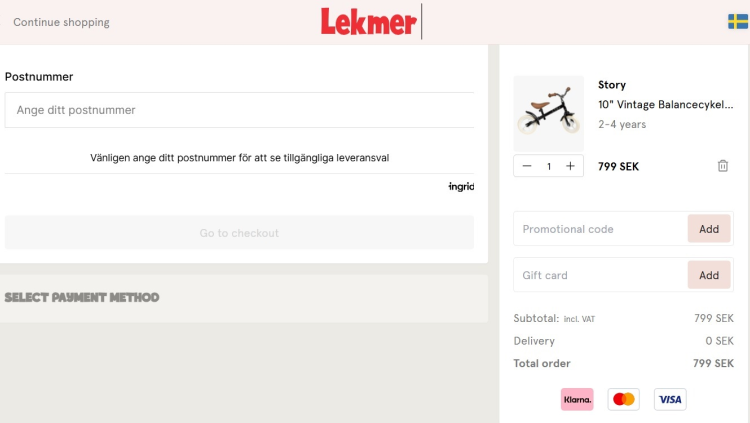
Forbytes applied all of these steps for one of our e-commerce clients. See the result:
Source: Lekmer
10. Don’t lose sales at the last step: offer the right payment mix
10% of shoppers will leave a purchase behind if they don’t see a payment method that works for them. 8% will leave after their card has declined for some reason.
There are a lot of payment options you can offer to your customers. But firstly, let’s see how payment preferences may vary:
- Preferences by generations: Your Gen Z and Millennial customers may lean toward BNPL and mobile wallets. Senior user type can still reach for a credit or debit card first;
- Preferences change by country: If you own a global business, it’s important to know what options at checkout shoppers in Brazil, Germany, or Indonesia expect.
Not sure where to start? Check your analytics. If you see high drop-off rates at checkout, limited payment options might be the reason.
Also, you can contact Forbytes at any moment, so we can help you integrate new payment systems into your existing setup without rebuilding everything from scratch.
How Forbytes Implements E-commerce Website Best Practices to Help Clients Grow
Our clients often ask us to help improve their online stores with e-commerce best practices. They turn to us to achieve the following goals: boosting sales, optimizing their platforms, and creating a better experience for their customers. At Forbytes, we love sharing success stories.
One of our clients, Lekmer.se, is a top online store in the Nordics for children’s products like toys, clothes, baby gear, and more.
As their customer base grew, Lekmer faced challenges with performance drops and traffic spikes. Here’s how we helped with the integration of e-commerce best practices:
First, we added user-friendly features like wishlists and product reviews, making the shopping experience more engaging.
Second, we integrated tools for smoother operations, including shipping services, popular payment methods, and a CDN to handle high traffic efficiently.
After the work was done, the client received an upgraded website with features that enhanced customer experience, boosted sales, and handled traffic spikes with ease.
Now, Lekmer can focus on delighting their customers while we ensure their platform runs smoothly.
Looking to Fuel your Online Store with E-Commerce Best Practices?
To sum up, there are plenty of other e-commerce best practices to explore. But starting with the ones we’ve mentioned above can help your online store achieve profitable results.
Looking to improve your platform, but unsure where to start? At Forbytes, we tailor e-commerce best practices to fit your unique needs. Our proven approach has delivered success for many of our clients.
We offer expert e-commerce consulting services and an actionable plan to help you succeed in your vertical. Need more? We build custom e-commerce solutions – from responsive online stores to automation tools, ensuring your business is secure, scalable, and ready to grow.
Let’s team up to turbocharge your online store with e-commerce best practices to unlock its full potential.
Share:
-
-
-
Successfully copied
-

Yuliia Pushkarska
Author
As a Content Writer at Forbytes, my mission is to create captivating and informative content based on the company’s values and expertise. My articles aim to educate readers on complex technical concepts and communicate our developers’ strategies for tackling business hurdles. With a passion for storytelling and interview articles, I strive to make our tech content engaging and unique, encouraging our audience to read it in one breath.
FAQ
What are e-commerce best practices?
E-commerce best practices are proven strategies that help online stores attract customers, reduce friction, and increase sales. They cover everything from site speed and navigation to checkout flow and payment options.
How do I know which e-commerce practices my store needs most?
Start with your analytics. Look for where shoppers drop off — that’s where your biggest problems are:
- High bounce rates on product pages point to poor descriptions or slow page load speed;
- High drop-off at checkout points to friction in the payment or form flow;
- Low search bar usage might mean your navigation isn’t working.
Fix the biggest leak first, then move down the list with the help of a dedicated development team.
How long does it take to implement e-commerce improvements?
It depends on the scope. Simple changes, like a mobile optimization or improving product descriptions, can be done quickly. Bigger integrations, like a recommendation engine, take more time and planning.If you are not sure about where to start and what to improve, feel free to contact Forbytes and ask any questions you would like to have an answer to.
Do I need a full website rebuild to apply these practices?
Not necessarily. Most improvements can be added to your existing setup through integrations and targeted development — no full rebuild required.
Can Forbytes help with all of these best practices?
Absolutely. Forbytes can start small — a single integration or a specific fix your store needs right now. If you’re ready to go bigger, our e-commerce consulting helps you figure out where to focus, and our e-commerce development team handles the build.
Let's Get in Touch
Forbytes created an app that allowed users to quickly measure themselves to be fitted for custom shirts. As a result, we could increase our speed, quality, and shirt output per week. Forbytes was dedicated to delivering a solution that accurately addressed our needs.
Forbytes’ engineers and team leads worked as part of our RnD group and were directly managed by our company directors. They were both proactive and adaptable, qualities that perfectly match our needs in our fast-growing and constantly evolving environment.
Forbytes has a strong process-oriented way of leading the company, with good respect for themselves and their managers. They made a choice not to become too big but build slowly on more qualified people, which is paying off.
Niklas Hammar
COO & Business
Development at Offerta.se
Our e-commerce site saw online inquiries and orders rise after working with Forbytes. The team used top-notch expertise to inform their suggestions and improvements. Constant communication, quick responses, and prompt delivery made for a smooth and enjoyable collaboration.
The Forbytes team was very professional and demonstrated a great understanding of the business aspects. All tasks were completed above expectations. Their experts were always available, and we never needed to wait for a response or a suggested solution.

Wondering whether financial business intelligence (BI) is a prospective investment for your company? Then look at what Forrester predicts for this year:
- More than 50% of under-50 FinTech users will refer to GenAI tools for financial advice. GenAI tools collect financial data and let the audience ask questions, get meaningful answers, and make the right budgeting decisions. Financial BI can be trained on the same data as GenAI. If you’re already using AI in your business, implementing BI will be a natural next step.
- Around 50% of Tier-1 financial companies will implement smart agents for their back-office tasks. One-third of all back-office responsibilities will be automated with smart technologies, including BI and AI. Each step and decision will be data-driven and orchestrated. This will mark a shift from generic workflows to role-specific and automated operations.
So, you see, if you’re already collecting financial data on a daily basis or using AI in your operations, you have a solid foundation for implementing financial business intelligence. And this article will show you what steps to take to make this implementation smooth and hassle-free.
Keep reading to uncover the impact of financial BI on your business, top BI tools to consider, and key steps for implementing this technology in your FinTech company.
Why Business Intelligence for Financial Services Can Be Your Competitive Advantage
To put it simply, financial BI is like the brain of your company. It’s an umbrella term covering strategies, tools, methods, algorithms, and technologies used to collect and manage financial data. The main BI components include:
- Data sources: CRM, ERP, spreadsheets, or other databases from which data is extracted.
- Data warehouse: A centralized place for storing and organizing data.
- Online analytical processing (OLAP) tools: Algorithms for data analysis, pattern identification, and trend forecasting.
- Data visualization: Interactive dashboards for quick and easy access to data.
You can configure financial business intelligence differently, depending on your goals, timelines, budget, toolset, and expectations.
Apart from adaptability, business intelligence in finance also offers practical pros. Here are some of the technology’s benefits:
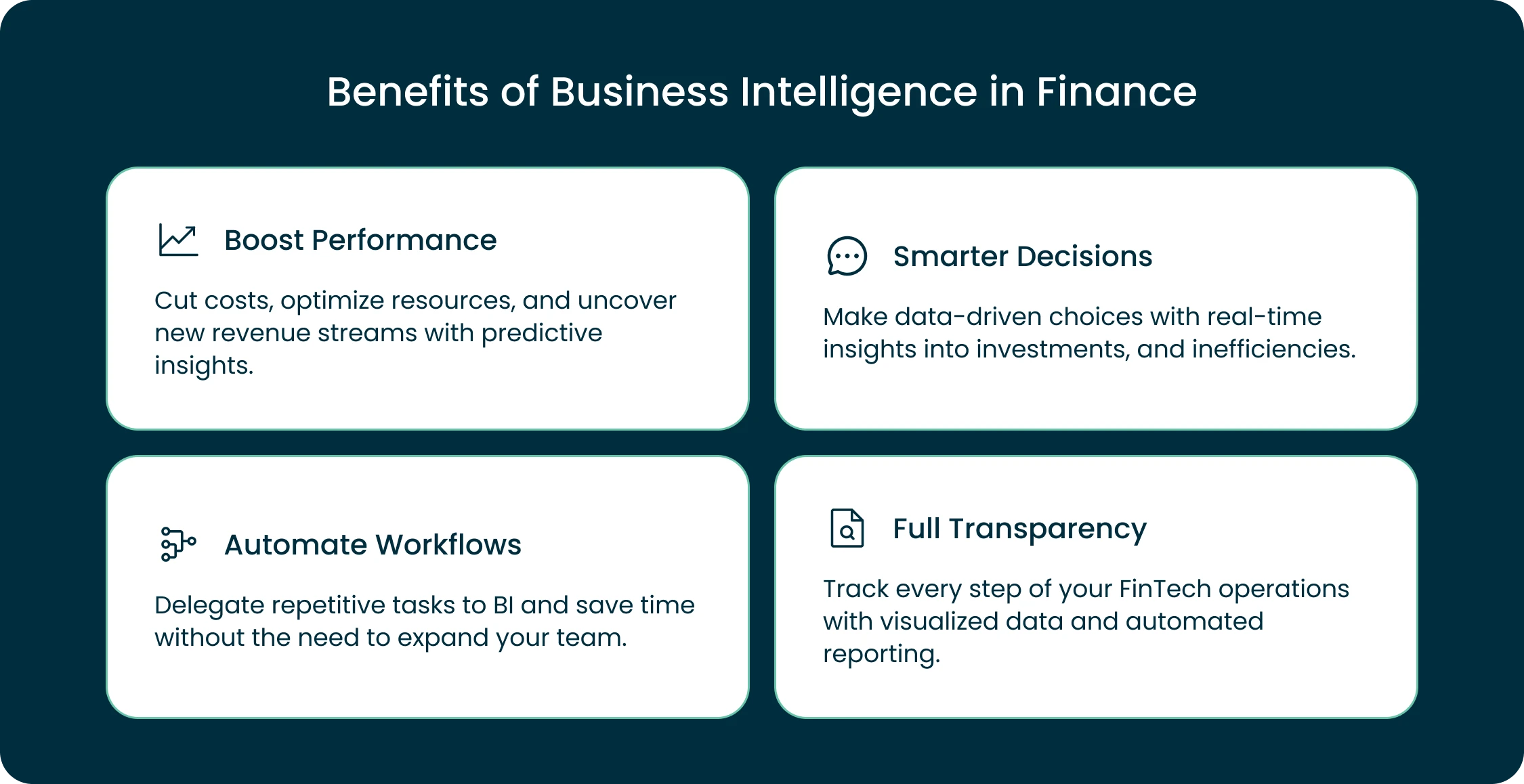
- You automate a large volume of work. A single BI investment handles data collection, management, and KPI analysis. Your company processes more work in less time without hiring additional staff.
- Your business decisions are smarter. With financial business intelligence, you get access to the latest data and insights into budgets, investments, and inefficiencies. You no longer rely on risky decisions or intuition but instead build a thoughtful business strategy, considering both your strengths and weaknesses.
- You gain more transparency. Any piece of raw data can be checked by BI stakeholders in real time. Enhanced by data visualization and automated reporting, business intelligence in finance makes it easier for non-technical staff to track every operational step. This ensures regulatory compliance and transparency throughout your organization.
- Your insights are data-proven. Based on historical trends and data analytics, intelligent technologies can predict what will happen in the financial sector tomorrow, including trends in customer behavior, sales, market fluctuations, and risk assessment. As a result, you can anticipate global changes and minimize disruptions to your business.
Looking to automate financial processes and save time? Get in touch with our team to streamline operations and reduce manual work.
How Business Intelligence Solves Real Financial Challenges
The positive impact of BI on financial businesses is undeniable. According to the latest data, more than 78% of global enterprises have implemented at least one BI or analytics platform by 2025. Often, one BI solution is enough for a FinTech company to reach all their business goals.
To figure out the project’s scope and the number of required solutions, you need to know how many BI applications your company needs to implement. Here are the core BI use cases in the financial sector to help you choose from:
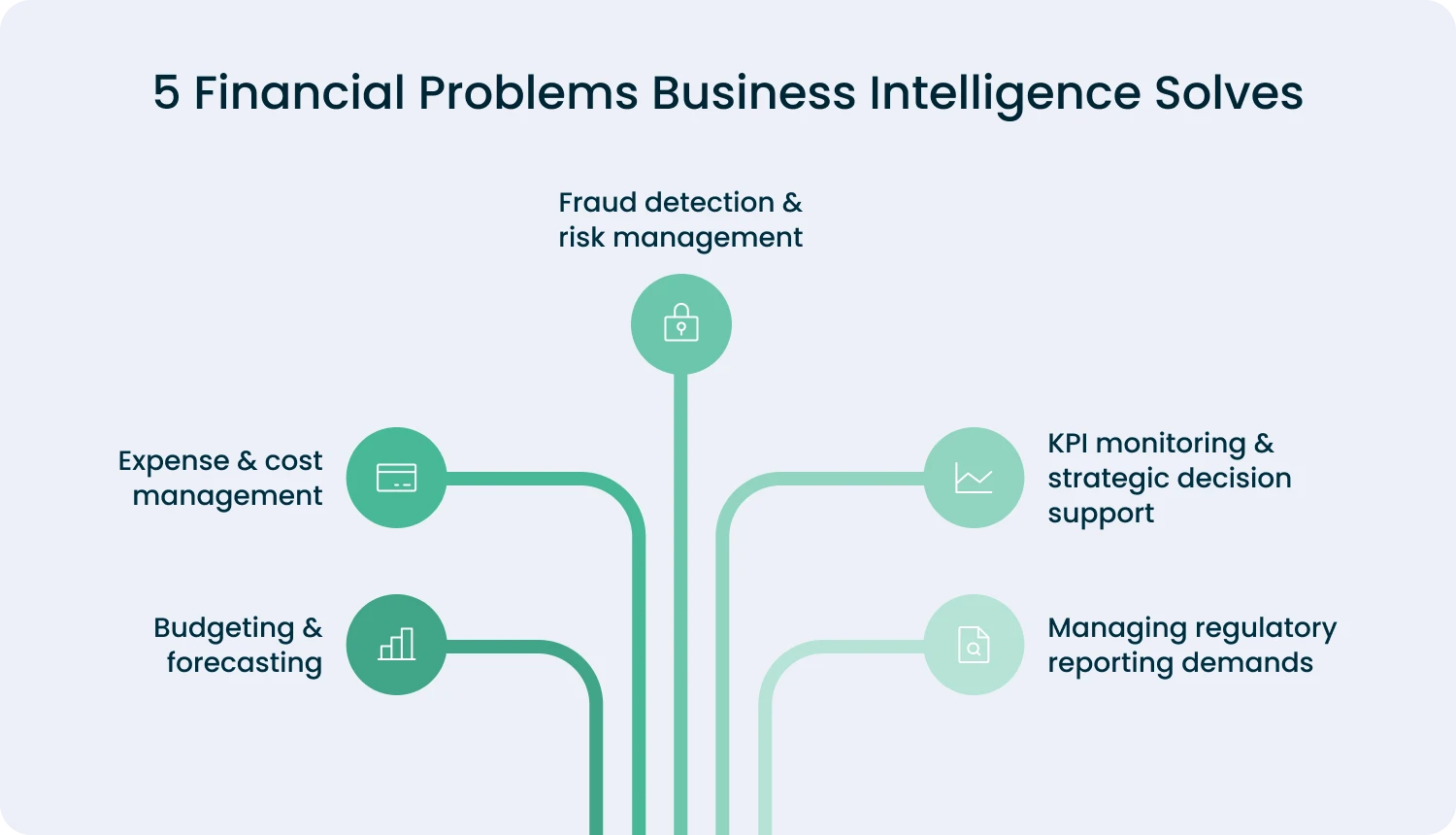
Fraud detection and risk management
To minimize fraud and manage risks, your company needs to analyze data in real time. Manual checks are almost impossible at scale, which is why financial professionals rely on BI tools.
Financial business intelligence solutions monitor vast volumes of raw financial data. They help you detect money laundering, spot identity theft, and prevent threats. Unlike static tools that are easy to bypass, ML fraud detection algorithms recognize patterns and proactively mitigate risks.
Expense and cost management
What differentiates business intelligence tools is their powerful cost management functionality. Business intelligence in finance collects raw data from multiple sources, creating a single source of truth for your finance department.
The system allows your teams to analyze data consistently, identify inefficiencies, and track key performance indicators without manual consolidation.
Do You Trust Your Financial Reports?
We help you consolidate data from multiple systems into one reliable source of truth.
Budgeting and forecasting
With predictive analytics and scenario modeling, BI solutions help finance teams track cash flows, expenses, and revenue. Changes in user behavior are detected automatically. This allows teams to adjust budgets dynamically.
KPI monitoring and strategic decision support
Financial BI centralizes key metrics in one place, enabling teams to monitor KPIs, track growth, churn, and liquidity, and receive automated data-driven insights.
BI supports data-driven decision-making, risk management, and strategic initiatives like market expansion, pricing, or investment planning. The technology combines historical trends with predictive analytics, which helps identify trends and reduce uncertainty.
Managing regulatory reporting demands
If your business relies on industry standards or regulatory requirements like SOX or GDPR, business analytics systems can save your team weeks spent manually compiling reports. BI platforms automatically track and document financial transactions according to regulatory requirements and instantly generate audit-ready reports formatted to compliance standards.
Top Financial Business Intelligence Tools Companies Use to Drive Smarter Decisions
From practical experience, the most effective BI platforms for business intelligence in financial operations are Power BI, Tableau, and Looker. Nearly all companies we have worked with in the financial services industry rely on one of these tools for analytics and reporting needs. These platforms provide immediate access to complex financial data, which helps finance teams make informed decisions.
The mentioned BI solutions work particularly well for finance teams because they integrate with popular financial systems. In addition, they offer strong data transformation and visualization features. These capabilities are critical for analyzing customer data and tracking key financial metrics that measure an organization’s financial health.
We have hands-on experience with all three tools, so below are the main insights that can help you decide which option fits your team best. If you need expert guidance on choosing business intelligence tools, feel free to contact Forbytes.
Power BI

Power BI is a cloud-based BI solution by Microsoft that supports connections to more than 250 data sources.
- Pricing: Starts at approximately $14 per user per month, and the tool offers robust data modeling and transformation functionality.
- Best option for: Organizations already using Microsoft products like SharePoint, Dynamics, Azure, or Excel. Power BI integrates seamlessly into this ecosystem. This reduces setup time and lets you embed financial reports directly into existing workflows.
If you already have a Microsoft Office E5 license, Power BI is included at no extra cost. No wonder it has become the go-to choice for our clients in financial environments. Their teams use it daily to track actual financial performance and revenue streams. No additional software expense required.
Tableau

Tableau is part of Salesforce and connects to more than 150 data sources.
- Pricing: Tableau charges based on what users do in the platform. For the viewers who only need to see dashboards, the platform charges around $15 per month, while creators who build custom charts and reports pay up to $75 per month.
- Best option for: Organizations that prioritize polished and complex visualizations. In the financial industry, this level of sophistication helps teams identify patterns and gain a deeper understanding of historical data, supporting operational and strategic decisions.
In practice, Tableau performs just as well as Power BI for financial BI use cases. If your organization is not tied to the Microsoft stack and your team prefers Tableau’s interface, it is a perfectly valid choice to anticipate future trends and optimize marketing strategies.
Looker

Looker is a Google-owned, enterprise-focused BI platform.
- Pricing: Google Looker BI pricing depends on a few components: platform edition, user licensing, and conversational analytics usage measured in tokens. On Google’s website, you’ll only find token pricing — $3 per 1M input tokens and $20 per 1M output tokens. However, you can use their pricing calculator to estimate the cost for your particular use case.
- Best option for: Organizations that need to integrate dashboards into internal systems or customer-facing applications. Looker excels at embedded analytics, letting finance teams analyze banking trends and anticipate shifts in FinTech and industry markets directly within their existing tools.
One of Looker’s strongest advantages is collaboration. The BI platform allows multiple developers to work on the same dashboards simultaneously, providing valuable insights for larger analytics teams. Looker also supports data warehousing and data encryption, ensuring compliance with financial regulations.
Need Help Implementing BI the Right Way?
Forbytes will guide you through every step — from platform selection to go-live
Proven Approach to Implementing Business Intelligence in Financial Services
Now that you know a lot about BI, its benefits, applications, and top tools, we can move to the practical side of the question — implementing this technology in your business.
Below, we present a general strategy that breaks down into narrower steps depending on the project’s goals, chosen tools, and business expectations. Consider this strategy as a high-level guide to turning financial BI into your business power.
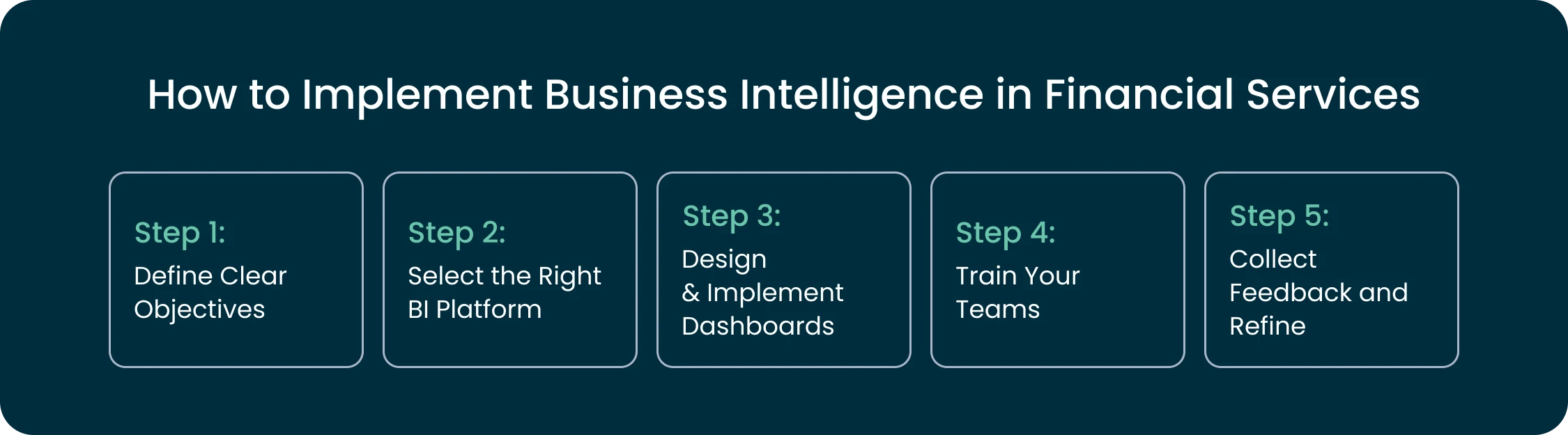
1. Define clear objectives
Start by outlining your goals for implementing business intelligence in financial services. Assess current data sources and make a list of the ones that your company will use for BI-driven data analytics:
- Select sources that provide accurate, complete, and timely data;
- Make sure the sources are regularly updated and can be integrated with other tools;
- Avoid including systems that don’t directly impact the metrics you want to analyze, because extra data adds complexity without value.
2. Select the right BI platform
he choice depends on your financial services industry segment. Retail chains often use Tableau to analyze customer data and improve marketing strategies. Meanwhile, FinTech companies might prefer Looker for historical data analysis.
It’s important to make this choice responsibly. The BI platform will form the core of your BI strategy, and you will spend time and resources on its integration into your IT environment. If you are hesitating between options, let our BI experts study your business and consult you on the most effective solution.
3. Design and implement dashboards
Dashboards display key financial metrics and allow teams to track actual financial performance. Properly designed dashboards improve strategic decision-making. They help leaders gain a deeper understanding of complex financial data.
What’s more, dashboards help non-technical team members access and interpret data. As a rule, non-technical teams have creative problem-solving skills that may be useful for your business strategy. Data visualization and dashboards help them access data directly, explore trends on their own, and contribute insights to financial discussions without needing technical expertise.
4. Train your teams
Implementing a smart solution is only halfway toward effective business functioning. Another part lies in the practical application of this solution by your team. You can spend a fortune on the most effective tools and get no results simply because your staff avoids using BI.
To prevent this, prepare a detailed training plan. Involve the specialists you engaged in BI development, organize workshops, and create questionnaires for your employees to share how the changes are going.
5. Collect feedback and refine
Continuous refinement allows organizations to maintain financial stability, improve data quality management, and optimize business operations. We recommend that you regularly collect team feedback on FinTech BI implementation.
The insights gained at this step will help you refine your BI strategy in a way that meets both your business objectives and internal operational needs.
Ready to Implement BI But Don't Know Where to Start?
Forbytes guides you through platform selection, dashboard design, and team training
Financial Business Intelligence Designed Around Your Reality: Real-Life Case Study from Forbytes
With BI, anything that can be translated into data becomes a powerful instrument for revenue growth and resource optimization.
Building an advanced BI platform for NoWaste is one of the success stories. Using it, we’ll show you the key benefits of business intelligence in finance and the well-planned implementation process.
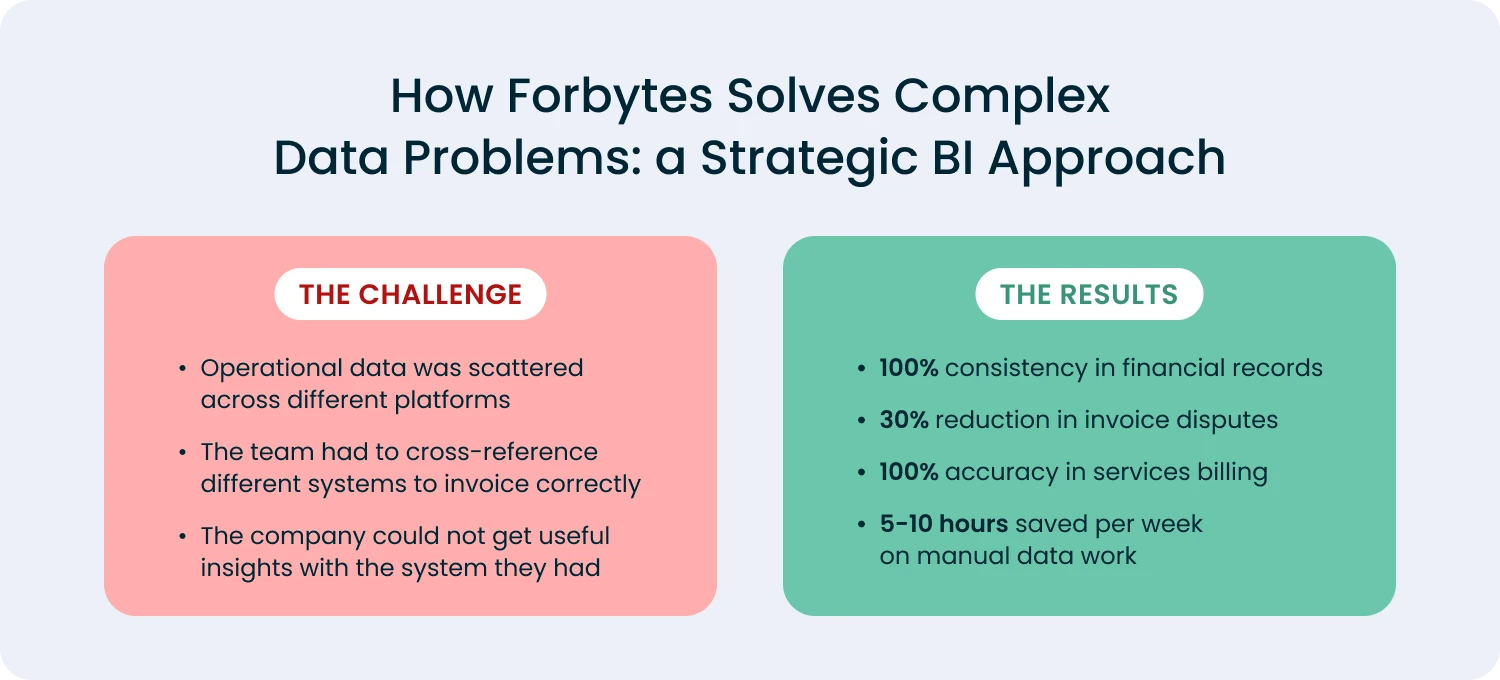
The challenge
NoWaste, a leading European logistics company, has systems that track everything from warehouse ops to billing.
What could be a problem if a company is already tech-savvy, you may ask? Simple as that: over time, all that data became impossible to manage:
- Their operational data was scattered across WMS, ERP, and HR platforms. Every time the team needed data, they should have manually pieced things together;
- The team had to cross-reference different systems to invoice correctly.
- NoWaste couldn’t get useful insights with the system they had.
Forbytes’ approach
The project was large and took 30 weeks to implement. We delivered strong results because of two factors:
- NoWaste knew exactly what they wanted to achieve and prepared solid documentation;
- Forbytes’ team aimed to design a solution that tackled each pain point and created a step-by-step BI implementation strategy.
Here’s what our team did to address the challenge:
First, we pulled data from all NoWaste source systems and converted it into Parquet files (a super-efficient file format for storing massive amounts of data). Then we set up ETL pipelines using Databricks to handle ongoing data loads.
Then, Forbytes’ team implemented Medallion Architecture on Azure:
- Bronze layer: Raw data straight from the source systems; we need to keep it for historical records and auditing;
- Silver layer: The system matches, merges, and standardizes the data here; this is the “single source of truth”;
- Gold layer: On this level, business-ready data is enriched and optimized for reporting.
The next step was doing heavy lifting like calculations, transformations, and all the business logic inside Databricks. We managed to do it using dbt (the industry standard tool).
As a final stage, Forbytes developed Power BI dashboards that turned complex data into efficient reports.
The results
- Data accuracy: NoWaste hit 100% consistency in financial records and cut invoice disputes by 30%.
- Zero revenue leakage: Now the company is capturing and billing 100% of services.
- Speed: Reports now generate in seconds.
- Time saving: Each department is saving 5-10 hours per week on manual data work.
Your finance team can have the same clarity and control with the right BI implementation. Contact us to see how we can build a solution for your business.
Share:
-
-
-
Successfully copied
-
Anzhelika Danielkievych
Author
My mission at Forbytes is to help our IT experts share complex information in plain language. The articles we produce reflect our expertise and help readers keep pace with the market trends and insights. We strive to educate, inspire, and empower our audience through compelling content that tackles the intricacies of the IT world and makes it accessible to all.
FAQ
1. What is financial business intelligence, and why is it important?
Financial business intelligence (BI) is an umbrella term covering strategies, tools, methods, algorithms, and technologies used to collect and manage financial data.Companies implement financial BI to keep their data in order, generate meaningful insights they can rely on, and use these insights to introduce positive changes to their businesses, whether for resource optimization or profitability growth.
2. How can FinTech BI improve my company’s performance?
BI allows finance teams to monitor key metrics, forecast trends, and identify inefficiencies. Companies get clear reports, allowing for 360-degree visibility of a business.By analyzing this data in real time, businesses see what drains their budgets, which tasks are most time-consuming, and what resources they lack. The conclusions made from such an analysis help FinTech organizations reduce costs, allocate resources more effectively, and uncover new revenue opportunities.
3. Is financial BI only for large companies?
No. While large enterprises benefit from scale, SMEs can also successfully implement financial BI. Modern cloud-based solutions are flexible and budget-friendly, making it possible for smaller teams to start with business intelligence without heavy investments.On top of that, the earlier your business starts with BI, the better it will establish financial discipline from the ground up and create a scalable framework for growth that doesn’t require costly overhauls later.
4. How quickly can my company see results from implementing business intelligence in finance?
Results vary by organization and the key metrics set. In our practice, companies notice improvements in reporting speed, accuracy, and decision-making within weeks. Our engineers will create a tailored strategy, so your business sees initial positive results quickly.
5. How do I start using business intelligence for financial services?
Begin by defining clear objectives, assessing your data sources, and choosing a platform that fits your business needs. Train your team and set up dashboards for key metrics.And if you need help with any of these steps, contact us. With 15+ years of experience, we know how to configure BI, so it turns from an auxiliary tool into a next-generation business foundation.
Let's Get in Touch
Forbytes created an app that allowed users to quickly measure themselves to be fitted for custom shirts. As a result, we could increase our speed, quality, and shirt output per week. Forbytes was dedicated to delivering a solution that accurately addressed our needs.
Forbytes’ engineers and team leads worked as part of our RnD group and were directly managed by our company directors. They were both proactive and adaptable, qualities that perfectly match our needs in our fast-growing and constantly evolving environment.
Forbytes has a strong process-oriented way of leading the company, with good respect for themselves and their managers. They made a choice not to become too big but build slowly on more qualified people, which is paying off.
Niklas Hammar
COO & Business
Development at Offerta.se
Our e-commerce site saw online inquiries and orders rise after working with Forbytes. The team used top-notch expertise to inform their suggestions and improvements. Constant communication, quick responses, and prompt delivery made for a smooth and enjoyable collaboration.
The Forbytes team was very professional and demonstrated a great understanding of the business aspects. All tasks were completed above expectations. Their experts were always available, and we never needed to wait for a response or a suggested solution.

78% of organizations say they struggle to keep up with today’s pace of change, and that concern is reasonable. Without emerging technologies like AI integration, cloud-native solutions, and business intelligence and analytics, staying competitive is becoming increasingly difficult.
What’s truly impossible is driving innovation when a company still depends on legacy systems. In 2026, legacy application modernization is not just a technical upgrade. It’s a critical business investment that helps companies strengthen security, improve user experience, and stay flexible every day.
Forbytes is here to explain why 2026 will be a defining year for business application modernization and which trends companies should watch to stay ahead.
Why Application Modernization Becomes a Business Priority in 2026
If you still think that app modernization is something “extra” and you can postpone it, the facts below may change your mind.
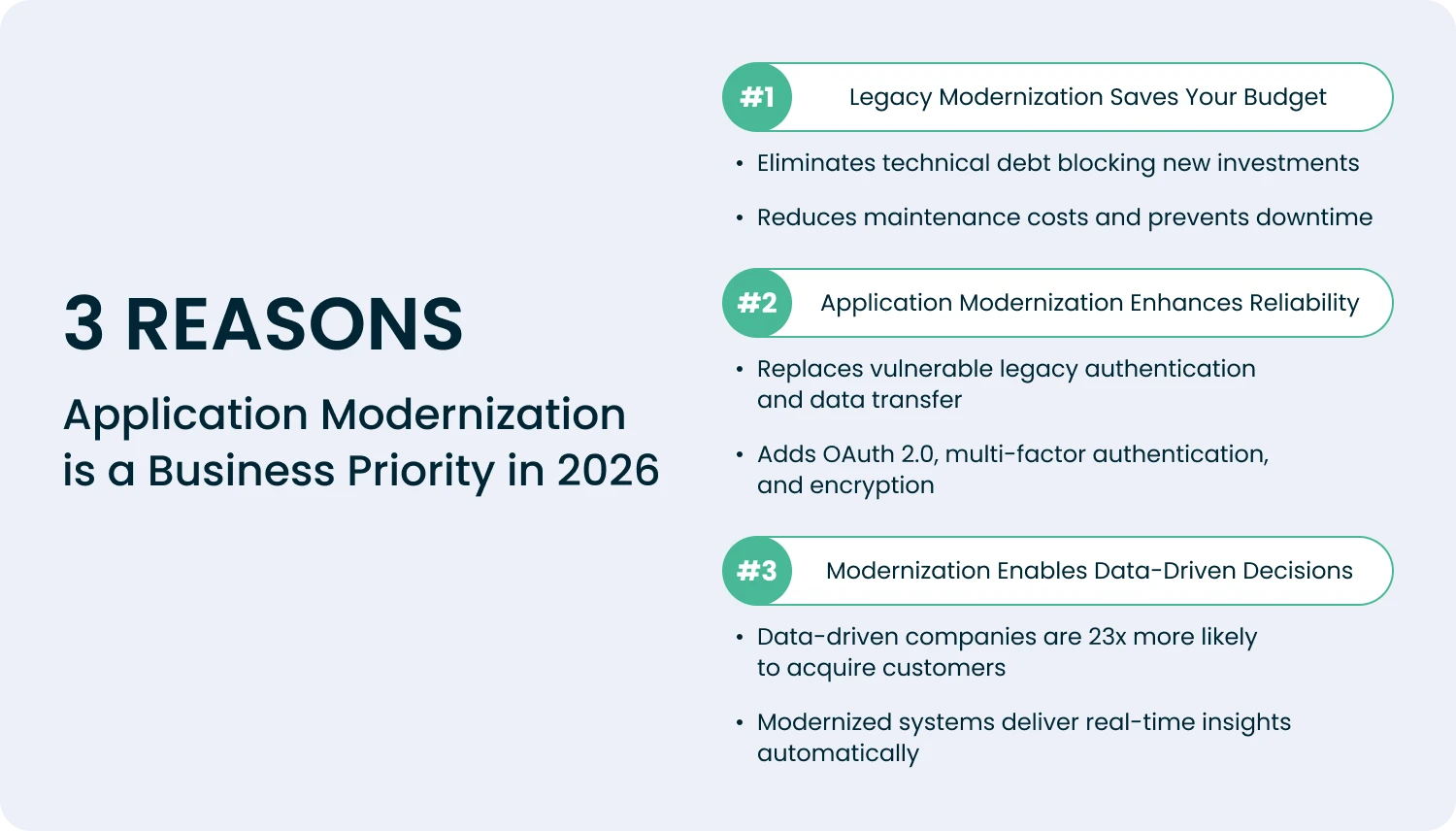
1. Legacy modernization saves your budget
Every day you put off application modernization, you’re not saving money; you’re spending it twice. Once to keep the legacy system operational, and again to deal with all the problems it causes.
Technical debt costs
56% of organizations say fixing technical debt consumes so much budget that they can’t invest in new technology programs. The money meant for growth simply gets redirected to keeping old systems running.
Infrastructure management costs
When you rely on outdated systems, you invest money in maintaining those systems, including expensive licensing fees and hard-to-find specialists who know how to deal with old tech.
Modern applications run on widely used modern platforms or technologies, and developers actually want to work with up-to-date tech. As a result, organizations that once used application modernization services save $19.1 million over three years on application development-related infrastructure costs alone.
Downtime costs
Legacy systems’ architecture increases the possibility of another costly problem — downtime. Outdated systems typically run as single, monolithic applications on dedicated servers. If one component fails, the entire system goes down. The cost of the downtime? Averages $100,000 per hour for businesses.
Let’s Talk About Modernizing Your Application
Contact Forbytes 2. Application modernization enhances reliability
Legacy applications have vulnerabilities in authentication systems, unencrypted data transfers, and outdated protocols that hackers know how to exploit. Every day you keep these systems running, you’re accepting risks that your competitors may be avoiding.
Successful modernization initiatives support:
- Current security protocols like OAuth 2.0 for secure access management;
- Multi-factor and biometric authentication to prevent unauthorized access even when credentials are compromised;
- Built-in data encryption during storage and transmission to make sure no one can actually read your data if it’s intercepted.
3. Modernization process makes data-driven decisions possible
Data-driven decision making is a must for companies that want to have a competitive advantage, and the numbers back it up. According to McKinsey, data-driven companies are 23 times more likely to outperform their competitors in customer acquisition, 19 times more likely to stay profitable, and 7 times more likely to retain customers.
But data-driven decisions require modernized infrastructure. Without it, your systems can’t connect automatically, and insights don’t reach your team in real time. Instead, employees exchange data manually. They need to copy information from one system to another, wasting time and resources on work that should happen automatically.
Key Application Modernization Trends Driving Business Growth in 2026
Forbytes has been modernizing applications for over a decade. Here’s what we’re seeing shape up as the major application modernization trends for 2026.
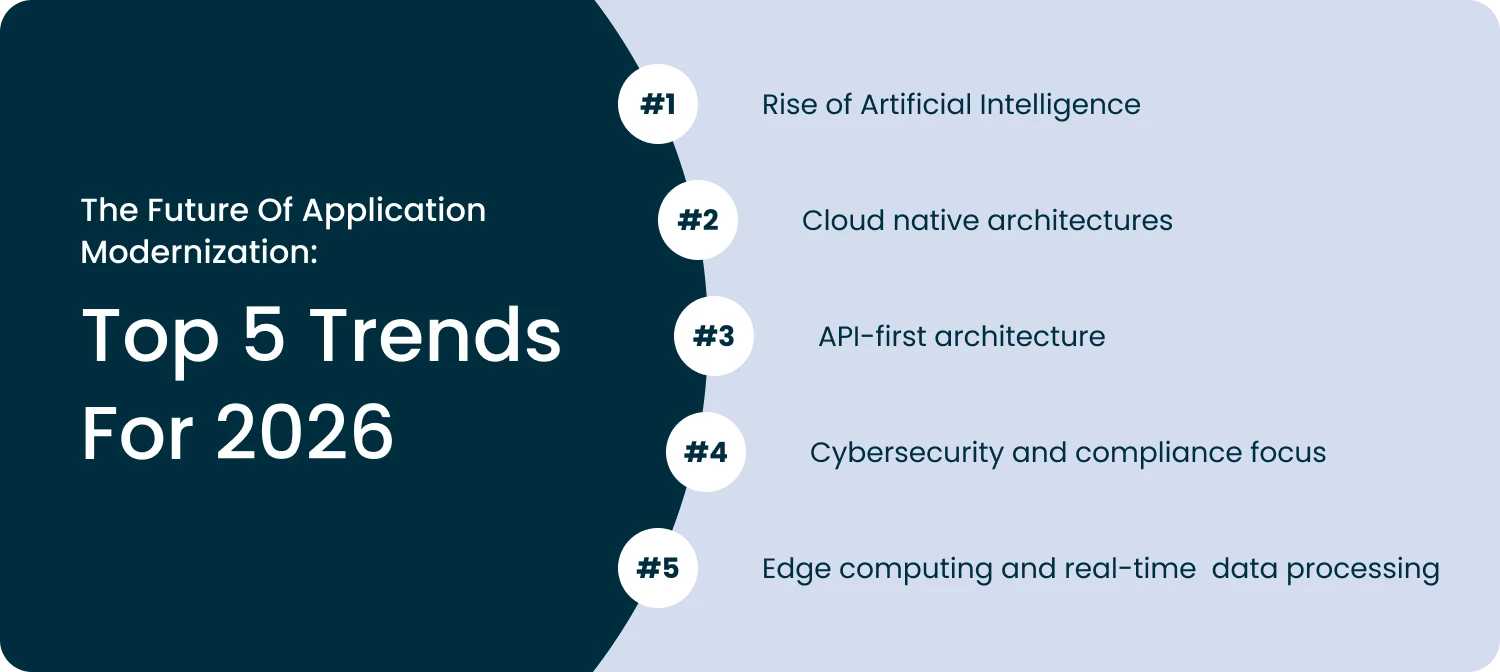
Rise of Artificial Intelligence
AI implementation continues to be the trend, with 91% of tech companies worldwide prioritizing investment in generative AI development for better analytics and automation of routine tasks.
AI is now also capable of improving legacy system modernization processes and reducing the risk of disruption during the production process. AI-powered tools analyze old code bases to identify dependencies, map data flows, and suggest refactoring strategies.
Cloud native architectures
AI tools depend on cloud native architecture to scale. Cloud apps use orchestration tools to automatically manage containers (lightweight packages that include everything the application needs to run) across servers. Instead of one large application running on a single server, cloud native applications break into smaller components that can scale independently.
Thus, 95% of companies are investing in cloud transformation, and most organizations do not view AI and cloud integrations as separate parts of application modernization.
Let’s discuss how to adopt these technologies without disrupting your business. Reach out to Forbytes.
API-first architecture
Businesses need to move faster than monolithic legacy applications allow. When your checkout process, inventory management, and customer data all live in one tightly coupled system, even one small improvement, like changing the checkout flow, means testing and redeploying everything.
API-first design stands for building the application’s communication layer before building the application itself. Every function exposes a clean interface that other systems can use.
Microservices take this further: instead of one monolithic legacy application handling everything, each business function becomes its own independent service.
Cybersecurity and compliance focus
Modern architecture operates on robust security measures, such as zero-trust principles. Every access request gets verified: authenticate the user, check their device health, confirm they have permission for this specific resource, and log the access.
Legacy applications often rely on perimeter security: once you’re past the firewall, you can access internal systems freely. Outdated systems lack the granular access controls, don’t log detailed audit trails, and store sensitive information unencrypted or use outdated encryption standards.
Compliance requirements are also getting more complex and start to affect database design, backup strategies, and how you route requests. For instance, data residency regulations like GDPR restrict where data can be stored and processed.
Edge computing and real-time data processing
Transferring data from a device to a cloud server and back takes time. For many areas, such as production lines or logistics networks, the shortest delay is unacceptable. Edge computing solves this problem by processing data on local devices or nearby servers.
Edge computing also reduces bandwidth costs and network congestion. A single manufacturing facility with IoT may have thousands of sensors collecting metrics every second. Streaming gigabytes of raw sensor data is costly and may overload the network bandwidth. So, instead of it, an edge device sends aggregated statistics or alerts only when values exceed thresholds.
Modernize Without Breaking Production
Contact Forbytes Today App Modernization Case Study: How Forbytes Prepared Guesty’s Platform for AI-First Development
But how does business application modernization look in real life, and what should business users prepare for? Forbytes is sharing the legacy modernization for Guesty case study. Here, we prove that with a dedicated development team, app modernization happens gradually and delivers improvements at every step.
Client’s modernization challenge
Guesty faced a problem that almost every growing business faces. They shipped features fast on a technical foundation built years ago in an outdated version of Node.js, stored in a single repository without TypeScript.
While this approach worked when the project was small, over time, the repository grew tangled and confusing. Engineers couldn’t see how the different parts connected. The team was not able to make changes because they couldn’t predict which part of the legacy application might break.
Engineers couldn’t use AI-powered tools for debugging or repetitive coding tasks either. When AI assistants tried to analyze such a large, unstructured codebase, they simply hallucinated.
Forbytes’ application modernization approach
Forbytes started by mapping what actually existed. Working with Guesty’s teams, we identified which parts of the legacy system caused the most problems and which domains needed digital transformation first.
We chose a gradual decomposition modernization strategy: move code from the monolithic repository into independent microservices, one domain at a time.
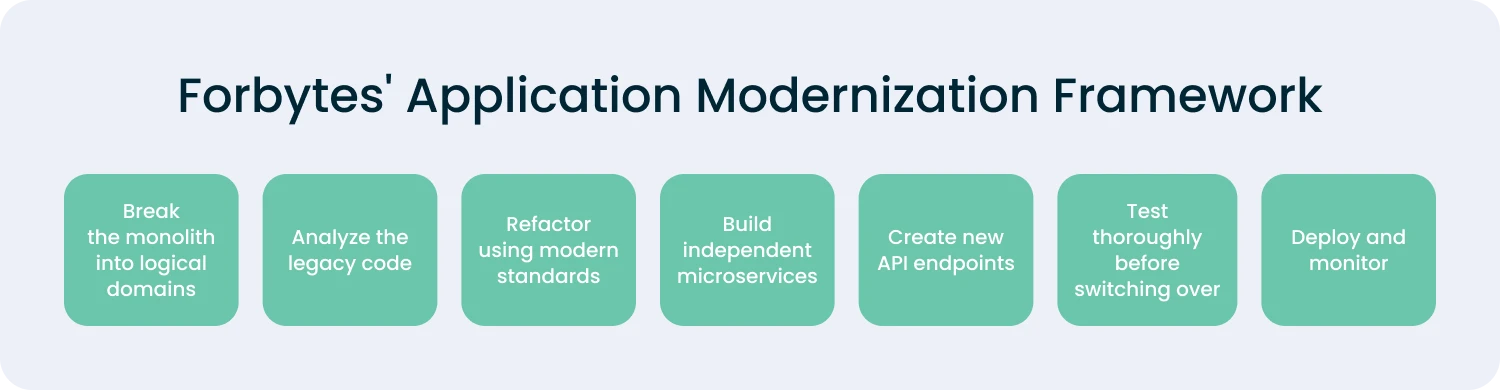
For each component, Forbytes followed a precisely built application modernization lifecycle:
- Break the monolith into logical domains. We separated the repository by business function, so rebuilding Guesty’s billing system was possible without touching the reservations or user management parts.
- Analyze the legacy code. Old code rarely comes with documentation that explains what it actually does, so we map out the logic, identify dependencies, and understand how data flows through the system.
- Refactor using modern standards. Forbytes’ engineers rewrote legacy codebases in TypeScript, restructured files into clearer patterns, and removed duplicate logic.
- Build independent microservices. Each service handled one domain with its own database, its own deployment pipeline, and its own scaling behavior.
- Create new API endpoints. Our team built new APIs for each service, separating business logic from infrastructure concerns, making the code testable.
- Test thoroughly before switching over. We ran comprehensive tests using Postman and automated testing frameworks to verify that the new service behaved exactly like the old logic. No traffic moved to the new service until we confirmed it worked correctly under production-like conditions.
- Deploy and monitor. After testing, we released the new service to production, monitored its performance, error rates, and system behavior to catch any issues immediately.
Then we repeated the process for the next domain.
Guesty’s platform now runs on a distributed architecture where each service can be developed, tested, and deployed independently. The structured codebase works effectively with AI assistants, and the modular architecture makes it straightforward to integrate new AI capabilities as Guesty builds them into their product.
Final Thoughts
Application modernization isn’t optional if you want your business to keep up. This one process can save you budget, keep your data protected, and ensure you can use any innovation you need.
AI-driven automation and cloud, edge computing, API-first architectures, and a focus on cybersecurity are among the top application modernization trends to watch and follow this year. But the key is having a trusted partner who can guide you through and make the application modernization process as smooth and impactful as it was for Guesty.
Ready to start your legacy system modernization process? Let’s talk.
Share:
-
-
-
Successfully copied
-

Daryna Hanhur
Author
My role is to make Forbytes’ expertise, which spans over a decade, noticeable to others. I believe that good content should make one thing clear: how the team solves real problems. That is why, as a content writer, I focus on highlighting the business value of Forbytes’ projects, the technologies used, and the challenges overcome.
FAQ
How do I know if my application needs modernization?
It’s time to modernize your application if you’re experiencing any of these signs:
- Developers spend more time debugging than building features;
- You can’t meet new regulatory requirements like data residency rules or detailed audit logging because your architecture doesn’t support them;
- You’re paying more for infrastructure, licensing, and maintenance, but the application isn’t getting better;
- You can’t adopt AI, real-time analytics, or mobile features, because your system can’t keep up.
Adding new features requires testing and redeploying your entire application instead of just the affected component.
How does application modernization reduce infrastructure costs?
Legacy systems require expensive licensing fees, dedicated specialists, and separate infrastructure management for each component.Modern platforms use cloud native applications that scale automatically and reduce operational overhead by an average of $19.1 million over three years.Moreover, successful modernization initiatives also reduce the risk of downtime, which averages $100,000 per hour for businesses running outdated systems.
Can we modernize without disrupting our production systems?
Yes, through gradual decomposition strategies. Instead of rebuilding everything at once, your team can break the monolithic application into logical business domains (billing, user management, inventory) and modernize one domain at a time.This app modernization approach maintains business continuity because critical systems never go fully offline.
Let's Get in Touch
Forbytes created an app that allowed users to quickly measure themselves to be fitted for custom shirts. As a result, we could increase our speed, quality, and shirt output per week. Forbytes was dedicated to delivering a solution that accurately addressed our needs.
Forbytes’ engineers and team leads worked as part of our RnD group and were directly managed by our company directors. They were both proactive and adaptable, qualities that perfectly match our needs in our fast-growing and constantly evolving environment.
Forbytes has a strong process-oriented way of leading the company, with good respect for themselves and their managers. They made a choice not to become too big but build slowly on more qualified people, which is paying off.
Niklas Hammar
COO & Business
Development at Offerta.se
Our e-commerce site saw online inquiries and orders rise after working with Forbytes. The team used top-notch expertise to inform their suggestions and improvements. Constant communication, quick responses, and prompt delivery made for a smooth and enjoyable collaboration.
The Forbytes team was very professional and demonstrated a great understanding of the business aspects. All tasks were completed above expectations. Their experts were always available, and we never needed to wait for a response or a suggested solution.


To be in vogue or not to be in vogue – that is not the question when it comes to e-commerce that penetrates all industries. The clothing business is no exception to the rules.
According to Precedence Research, in 2025, the global e-commerce apparel market size reached $779,30 billion, but it is projected to hit around $ 1,706,58 billion with a growth rate of 9,1 % by 2034.
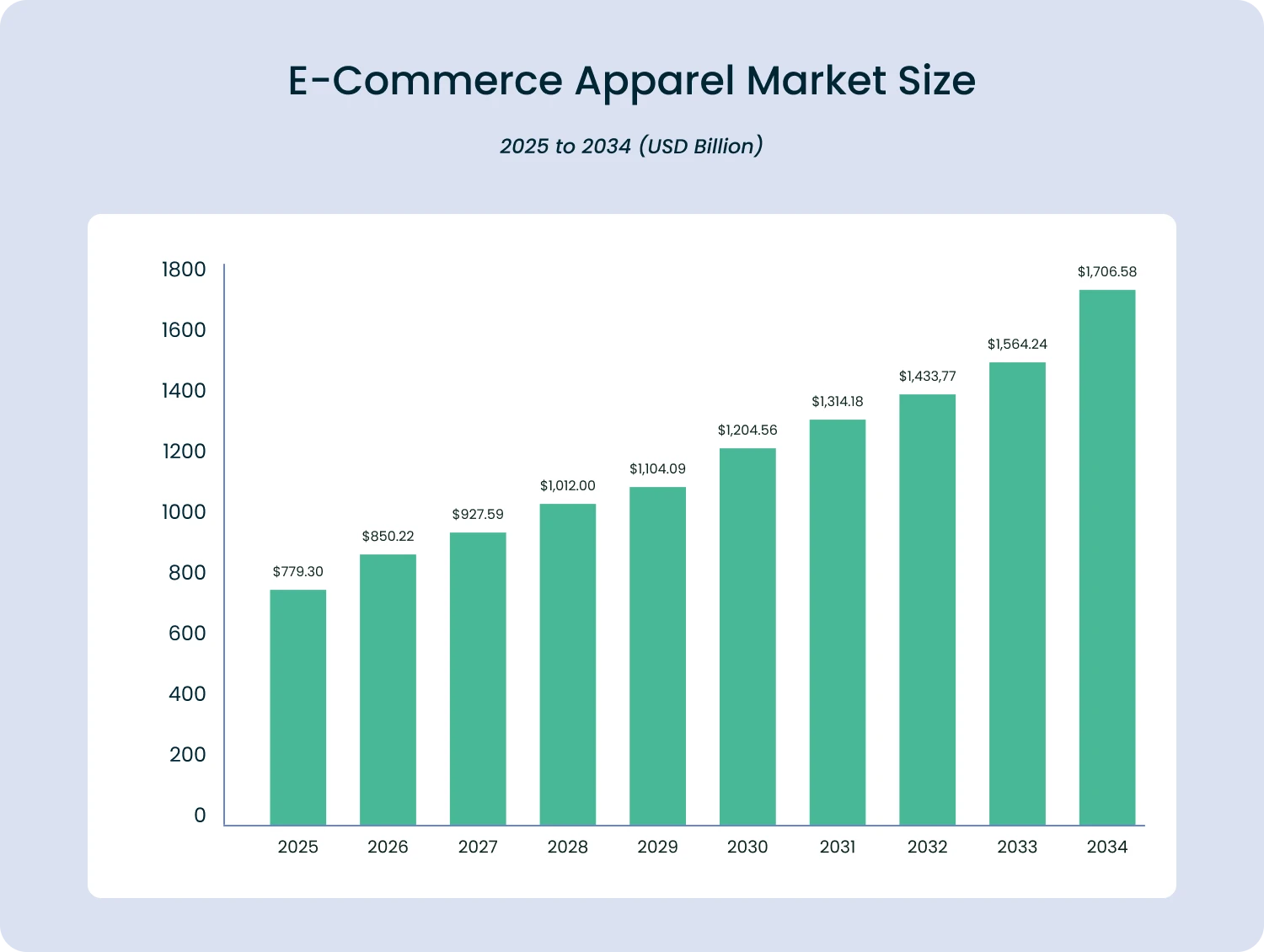
What are the reasons for the popularity of e-commerce in the fashion industry?
First, more and more people are using online stores for their apparel purchases. In 2024, retail e-commerce sales were $3,6 trillion worldwide. Second, e-commerce is now an essential tool for the fashion vertical. For example, fashion brands like Zara, Koton, boohoo, and SHEIN Technology LCC have become exceptional e-commerce clothing websites for a broad global audience.
So, we can say with confidence that e-commerce is transforming the fashion industry and influencing the market situation. What are the key online marketplace trends? And what awaits e-commerce clothing websites? We’ll cover that further down, so keep reading.
Benefits You’ll Get with an E-commerce Clothing Website
Not all fashion brands have e-commerce clothing websites, but this is just a matter of time. When they’re aware of the benefits they can get from marketplaces, they will prioritize online stores as much as brick-and-mortar shops and boutiques. So, let’s reveal how e-commerce can become the runway for fashion brands.
- Broad audience. One of the driving forces behind the popularity of apparel marketplaces is their unparalleled reach. Fashion platforms are becoming hubs for potential clients, contributing to better brand awareness and increased sales. Plus, with e-commerce clothing websites, companies are free from geographic constraints and can reach their clients globally.
- Increased sales. Another reason why fashion brands opt for marketplaces is their desire to boost their sales. And it truly works. For example, a Germany-based online fashion marketplace, Zalando, earned over 7 million euros in 2024. The company has a substantial customer base of over 50 million in 23 European countries.
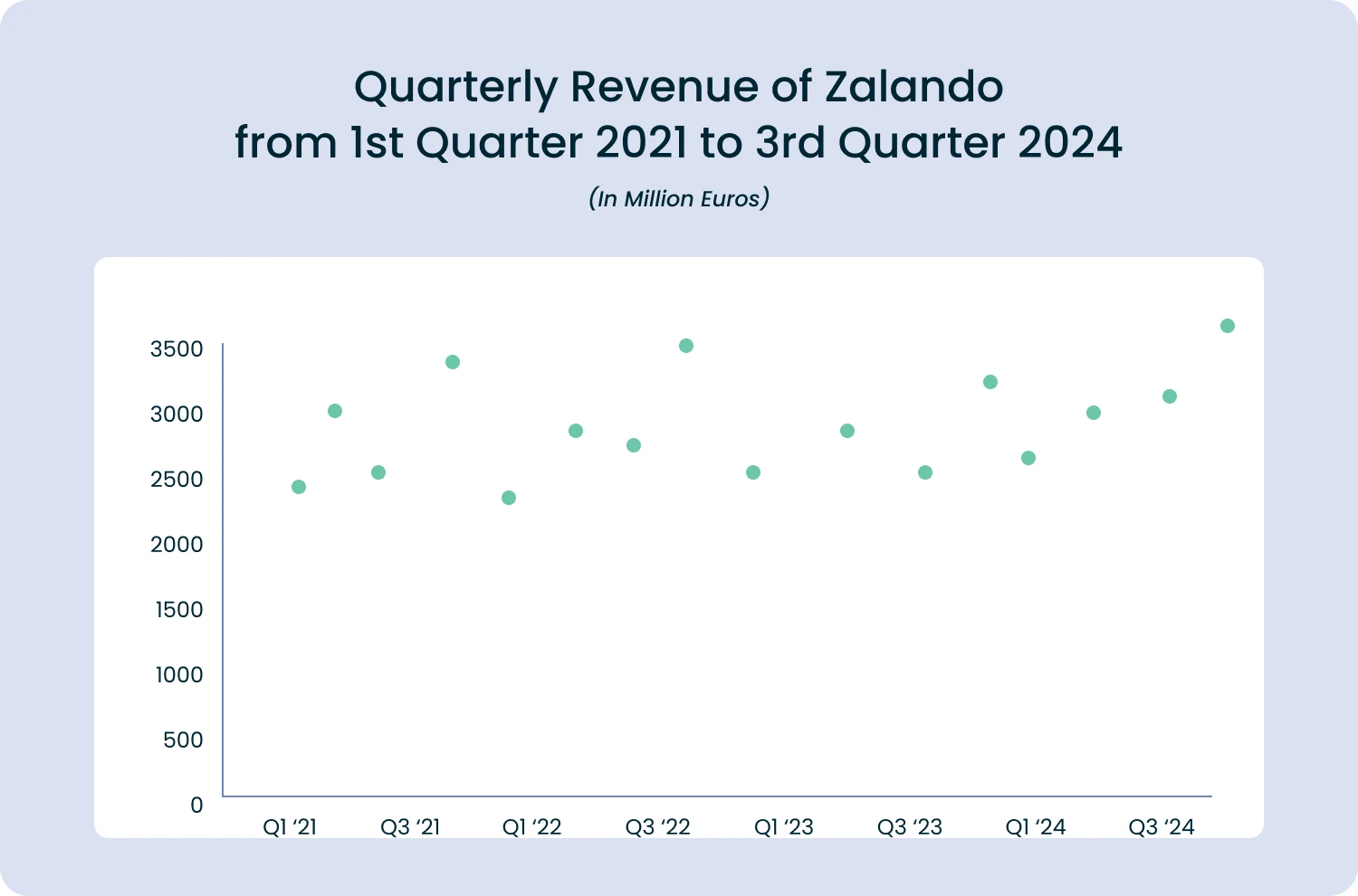
- Ready-made infrastructure. Starting a brick-and-mortar store can be a challenging task full of obstacles. But e-commerce clothing websites provide a ready-made infrastructure with an established customer base and efficient payment systems. This offers an easier way for emerging fashion brands to build their online presence.
- Efficient payment system. E-commerce websites offer robust payment gateways, enabling quick and secure purchasing processes. As a result, customers can feel safe and secure when sharing their payment information. By offering convenient payment methods such as Apple Pay or Google Wallet, e-commerce clothing websites can attract more shoppers.
- Global expansion. Marketplaces can be an efficient means of entering the global market. Thus, this is a chance for fashion brands to speed up geographic expansion and overcome hurdles associated with opening physical stores in new regions. For example, ASOS is one of the biggest e-commerce clothing websites with over 1,000 brands, operating in 196 countries.
Online Marketplace Trends to Consider in 2026
No doubt, e-commerce brings many opportunities and benefits. From secure services to dynamic and responsive communities, e-commerce clothing websites are transforming into more unique and advanced online stores. But what to expect from them in the future? Let’s discover what can help e-commerce platforms gain a competitive edge and succeed in the fierce rivalry.
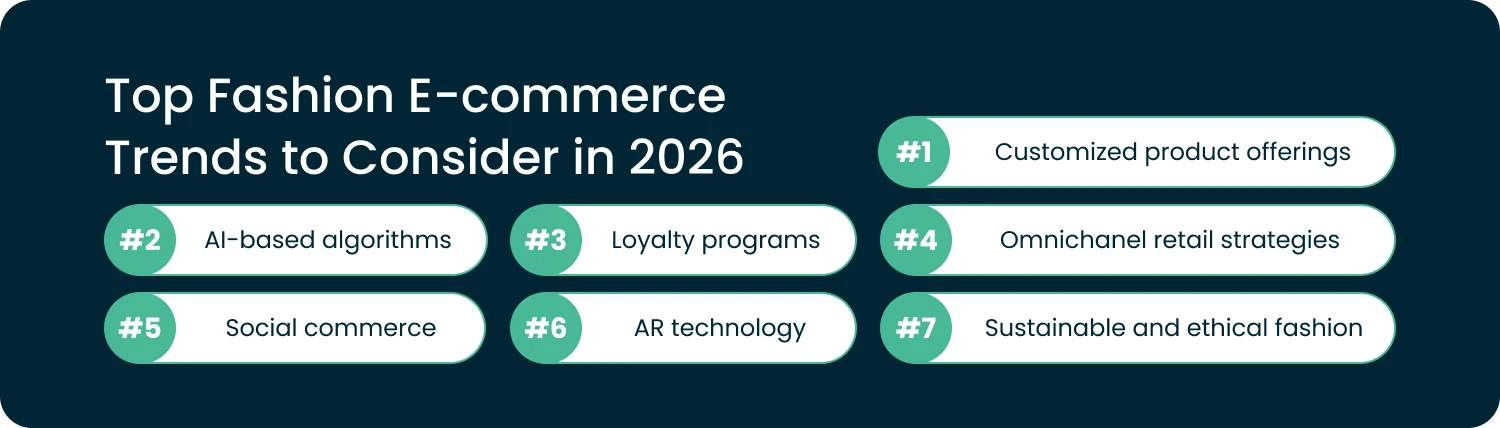
Customized product offerings
Personalization is more than a trend, it is already a key strategy used by fashion e-commerce to drive customer engagement and sales. Leading e-commerce clothing websites like Zara, ASOS, and Amazon Fashion apply customization to product offerings.
For example, Zara analyzes customers’ browsing and purchase history to offer them tailored product recommendations online. As a result, this fashion brand manages to provide a more personalized shopping experience.
When it comes to Amazon Fashion, it also uses recommendation engines by analyzing users’ activities and recommending clothes, shoes, and accessories aligned with their preferences. Such a strategy assists this e-commerce clothing website in creating products that are interesting for its target audience.
ASOS also adapts its website content to customer behavior by making it catchy and dynamic. As a result, customers can see only relevant content based on their recent search activity.
AI-based algorithms for personal recommendations
Fashion brands integrate AI-powered tools into their e-commerce clothing websites to provide real-time customer support, assist with size queries, and offer customized product recommendations. AI algorithms analyze consumer behavior to gain insights into their interests, preferences, and current needs. For example, browsing history can be used by AI to create personalized recommendations.
AI implementation into e-commerce platforms allows for adapting to changes in consumer behavior. By analyzing historical data, AI unveils valuable insights about consumer preferences and makes them more accurate over time.
For example, Gucci applies chatbots and live chat to ensure customer support across multiple channels. By offering personalized shopping, this fashion brand creates a more meaningful experience for the target audience.
Loyalty programs for enhanced customer experience
Fashion retailers offer loyalty programs to enhance customer experience and extend the client base. Additionally, loyalty schemes involve data gathering for personalized services and advanced marketing efforts. From point-based and subscription-based loyalty programs to reward and partner loyalty programs, retailers offer them to customers to better respond to their preferences.
For example, Nordstrom has a customized and sophisticated program based on customer spending and purchase history. This loyalty program encourages customers to repeat purchases. For the company, this is a chance to keep consumers engaged and satisfied.
Omnichannel retail strategies for a seamless shopping experience
Selling through multiple channels is another trend in the fashion industry. Companies feel a strong need to expand beyond a single e-commerce clothing website and develop various digital and traditional channels. This omnichannel strategy allows for the extension of physical and digital reach. Whether this is an e-commerce clothing website, marketplace, mobile app, or a brick-and-mortar store, each channel presents numerous opportunities for fashion brands.
The value of e-commerce integration is that it contributes to the delivery of a seamless and unified shopping experience across diverse channels. Additionally, this is a chance to ensure credibility and trust. For example, the presence of e-commerce clothing brands on established marketplaces such as Etsy, eBay, and Amazon can help them create trustworthy relationships with customers.
Need To Modernize Your E-Commerce System?
Transform your legacy store into a scalable, cloud-based platform.
Social commerce for better connecting with the audience
Social commerce is a driving force in the growth of e-commerce clothing websites, transforming how they connect with their customers. What’s more, social commerce drives sales. A seamless merging of social media with online shopping breaks down barriers between them and allows customers to purchase products without leaving social apps.
Influencer marketing has become an integral part of social commerce. Fashion brands involve celebrities and influencers to market their products through social media. As a result, influencers connect e-commerce clothing websites with their followers by making them the target audience. For example, Zara and H&M use TikTok to showcase their latest collections, directly linking users to their online stores.
The integration of AR technology
The integration of AR technology into an e-commerce clothing website is another trend used by fashion brands to innovate and captivate their target audience. The value of augmented reality is that it merges the digital and physical worlds. From a try-before-you-buy approach and personalized fit visualization to enhanced online engagement and sustainable fashion practices, these are benefits that e-commerce clothing websites try to deliver to their clients.
Famous fashion brands, such as Gucci, Adidas, Nike, Burberry, Tommy Hilfiger, and Zara, use AR to provide innovative solutions ranging from unique marketing experiences to virtual try-ons. For example, Nike uses AR tools for sneaker releases, enabling customers to try on shoes through their app in real time.
Sustainable and ethical fashion
More and more consumers are paying attention to the quality and sustainability of their clothing choices. Therefore, fashion brands try to offer stylish designs crafted with longevity, care, and eco-friendliness in mind.
Apparel companies tend to prioritize a lower carbon footprint, ethical sourcing, and premium materials. No doubt, this is a good way to reach a conscious target audience. But this is also a way to improve business reputation and image in the market. This growing fashion trend shows a change in values and establishes new standards for e-commerce clothing websites in 2026.
How Forbytes Approaches Digital Transformation of E-Commerce Clothing Websites
At Forbytes, we have an on-point story to share about how we contributed to the digital transformation of our client’s e-commerce clothing website.
Stenströms is an elite fashion brand, well-known in Europe and North America, boasting a wide distribution network. The company has 103 stores in the USA, 131 in Belgium, 116 in Germany, 166 in Sweden, and more.
Initially, Stenströms managed to respond to their customers’ needs, staying committed to their personalized clothing design and product. But over time, the number of clients increased, and the company faced the dilemma of how to avoid performance drops and cater to the needs of all clients while preserving their personalized approach.
Therefore, Stenströms turned to Forbytes to build business automation software to reduce manual work, cut the number of mistakes and delays, and make their business more efficient. So see how we approached our client’s challenge.
First, Forbytes built a Made-to-Measure (MTM) system to automate order processing to save time for retailers, speed up production, and increase the number of custom-made shirts. As a result, Stenströms succeeded in providing their clients with high-quality clothing items.
Second, we ensured the MTM system we built would allow for instant order and client measurement verification and validation. We helped our client avoid mistakes, delays, and poor use of resources. As a result, retailers could provide clients with perfectly tailored products.
So, the digital transformation of an e-commerce clothing platform is a continuous process that involves adopting new trends and integrating the latest technologies.
Final Thoughts
All in all, the fashion industry doesn’t stand still and demonstrates steady growth driven by digital trends. The main reasons why fashion businesses tend to transform into e-commerce clothing websites are a broader audience, increased sales, and global expansion. From AR and AI-based algorithms to omnichannel retail strategies and customized offerings, these are new trends that fashion companies integrate to transform their business.
At Forbytes, we offer digital transformation services to turn your brick-and-mortar stores into e-commerce clothing websites, ensure online presence, and extend the target audience. This enables businesses to boost sales and increase revenues. Our e-commerce expertise will help your company better connect with customers, ensure sales through multiple channels, and enhance customer experience.
Do you want to digitalize your solution together with Forbytes? Apply here to contact our team — we’re looking forward to connecting with you.
Share:
-
-
-
Successfully copied
-

Taras Demkovych
Author
As a COO, I strongly believe in the importance of technology for business success. In my opinion, incorporating technological advancement into the company’s DNA combined with strong leadership at all levels creates a business that will stand out. My focus lies in bringing this philosophy to the Forbytes team and extending this vision to our valued clients, helping them leverage technology for their growth.
Let's Get in Touch
Forbytes created an app that allowed users to quickly measure themselves to be fitted for custom shirts. As a result, we could increase our speed, quality, and shirt output per week. Forbytes was dedicated to delivering a solution that accurately addressed our needs.
Forbytes’ engineers and team leads worked as part of our RnD group and were directly managed by our company directors. They were both proactive and adaptable, qualities that perfectly match our needs in our fast-growing and constantly evolving environment.
Forbytes has a strong process-oriented way of leading the company, with good respect for themselves and their managers. They made a choice not to become too big but build slowly on more qualified people, which is paying off.
Niklas Hammar
COO & Business
Development at Offerta.se
Our e-commerce site saw online inquiries and orders rise after working with Forbytes. The team used top-notch expertise to inform their suggestions and improvements. Constant communication, quick responses, and prompt delivery made for a smooth and enjoyable collaboration.
The Forbytes team was very professional and demonstrated a great understanding of the business aspects. All tasks were completed above expectations. Their experts were always available, and we never needed to wait for a response or a suggested solution.

The future of e-commerce is uncertain. Retailers are looking for new opportunities and rethinking their approaches to online business. Why is that happening?
First, we face global inflation pressures that restrain the capacity to expand and affect potential customer decisions. Even the top e-commerce brands aren’t immune to these challenges and experience difficulties in advancing their growth.
Second, the costs of raw materials are increasing. And you have no other choice but to raise prices. But how to retain your regular customers and attract new ones if the worldwide crisis also influences them?
Luckily, e-commerce still has the strength to resist and use the situation in the market to bring exciting opportunities for both businesses and customers. This is happening because of the emergence of e-commerce trends that should be adopted to better respond to customer needs and fuel retail with the latest insights.
In this article, the Forbytes team will present the top e-commerce trends to consider in 2026 and show how to future-proof your online store. Hopefully, this info will lead you in the right direction.
What E-commerce Hurdles Await Retailers?
Despite retailers having high hopes for e-commerce, they should be aware of the hurdles awaiting them in 2026.
First, global inflation pressures are inevitable. According to Statista, 40% of the respondents say that inflation is their leading concern. 31% believe that it will reinforce the problem of poverty and social inequality, while 26% of respondents are convinced that inflation will cause unemployment.
What does it mean for retailers? Loss of regular clients, increased prices, and work in tough conditions, but that’s not all.
Second, e-commerce companies attached to the North American and European markets can lag behind those that operate in China. The studies show that China leads in global e-commerce sales, accounting for more than 50% of all global retail sales.
It means that retailers should either change their geographic focus or look for new ways to advance their tech growth to ensure a bright future for e-commerce.
Fortunately, online stores can manage these challenges in the following ways:
- Expanding their reach across channels to increase their customer base and revenue streams.
- Using customer data and analytics to fine-tune marketing strategies and boost ROI.
- Staying flexible and responding swiftly to changing trends in e-commerce shopping to remain competitive.
With these strategies in mind, let’s reveal key e-commerce trends that will fuel your company with tech solutions to help advance growth. Plus, they will make you immune to issues in the global market.
Which E-commerce Trends to Adopt in 2026?
According to Zion Market Research, by 2034, revenue in the e-commerce market is projected to reach $6.7 trillion with an annual growth rate of 15%. The number of users is expected to reach 3,5 billion, and user penetration will hit 48,3%. So see, the e-commerce market will grow significantly, offering more opportunities for online stores.
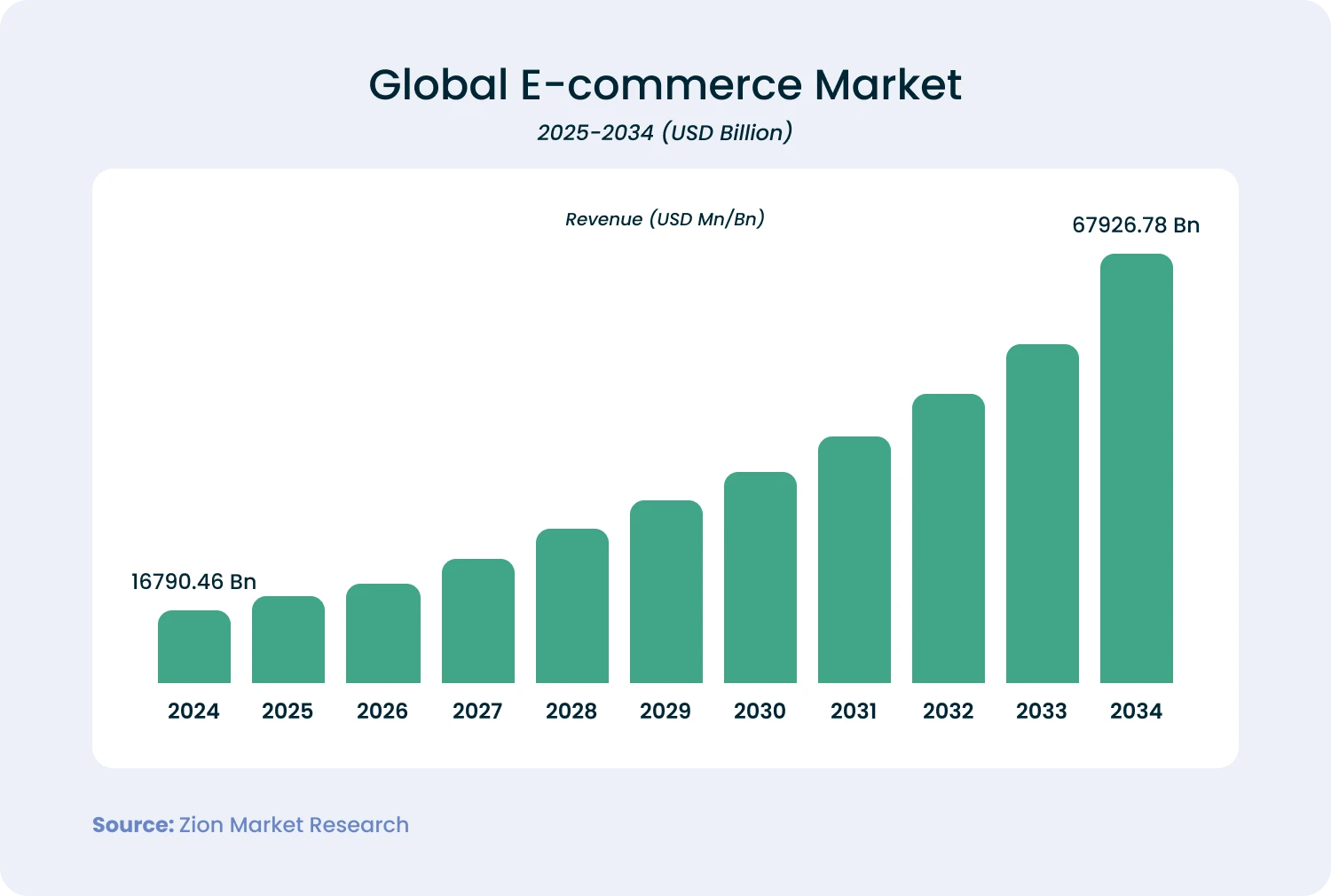
To stay ahead of the curve and remain competitive, it is a must for your e-commerce company to show dynamism and readiness to transform the way you conduct your business. In 2026, the following emerging online shopping trends will reshape the nature of e-commerce and bring more benefits to customers.
We’ll focus on those that are worth keeping an eye on and taking advantage of.
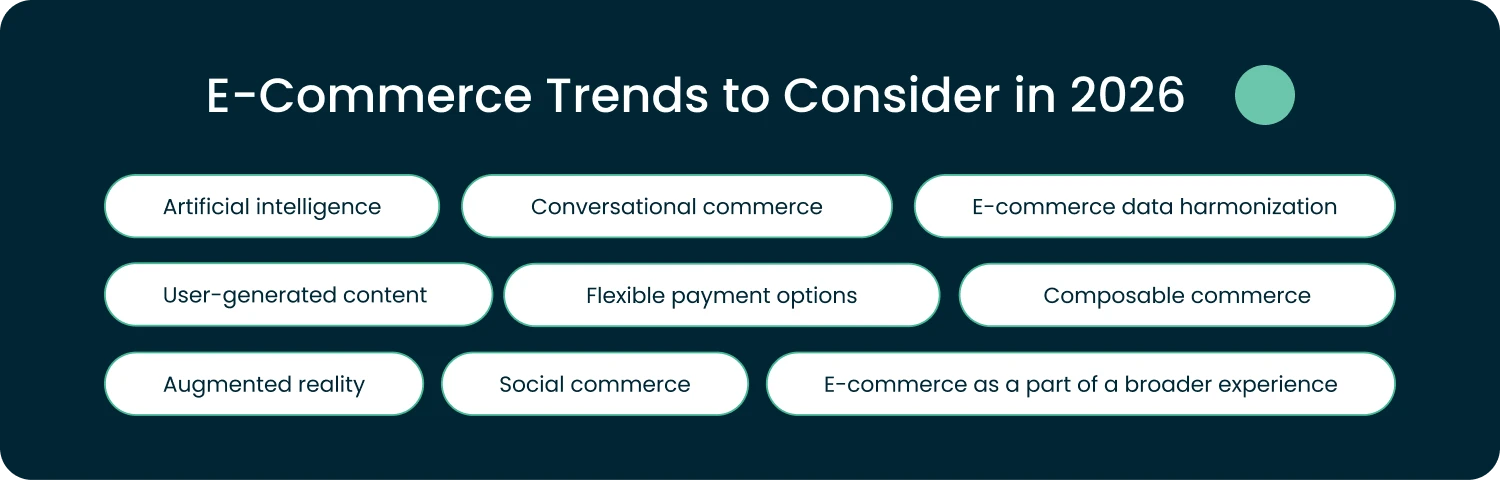
AI as an instrument for a highly personalized experience
No doubt, today, artificial intelligence is more than an e-commerce trend, it is an instrument used by online stores to offer highly tailored experiences. From recommended products and voice search to chatbots for 24/7 support, AI in e-commerce works for quality service and exceptional customer experience.
For example, e-commerce professionals from Europe reported that artificial intelligence could support many e-commerce activities from marketing automation (48.9%) or text analytics (20%) to pattern recognition (14%) or decision-making (13%). So, AI algorithms do more than recommend products; they analyze large volumes of consumer data to reveal their preferences and create customized shopping experiences.
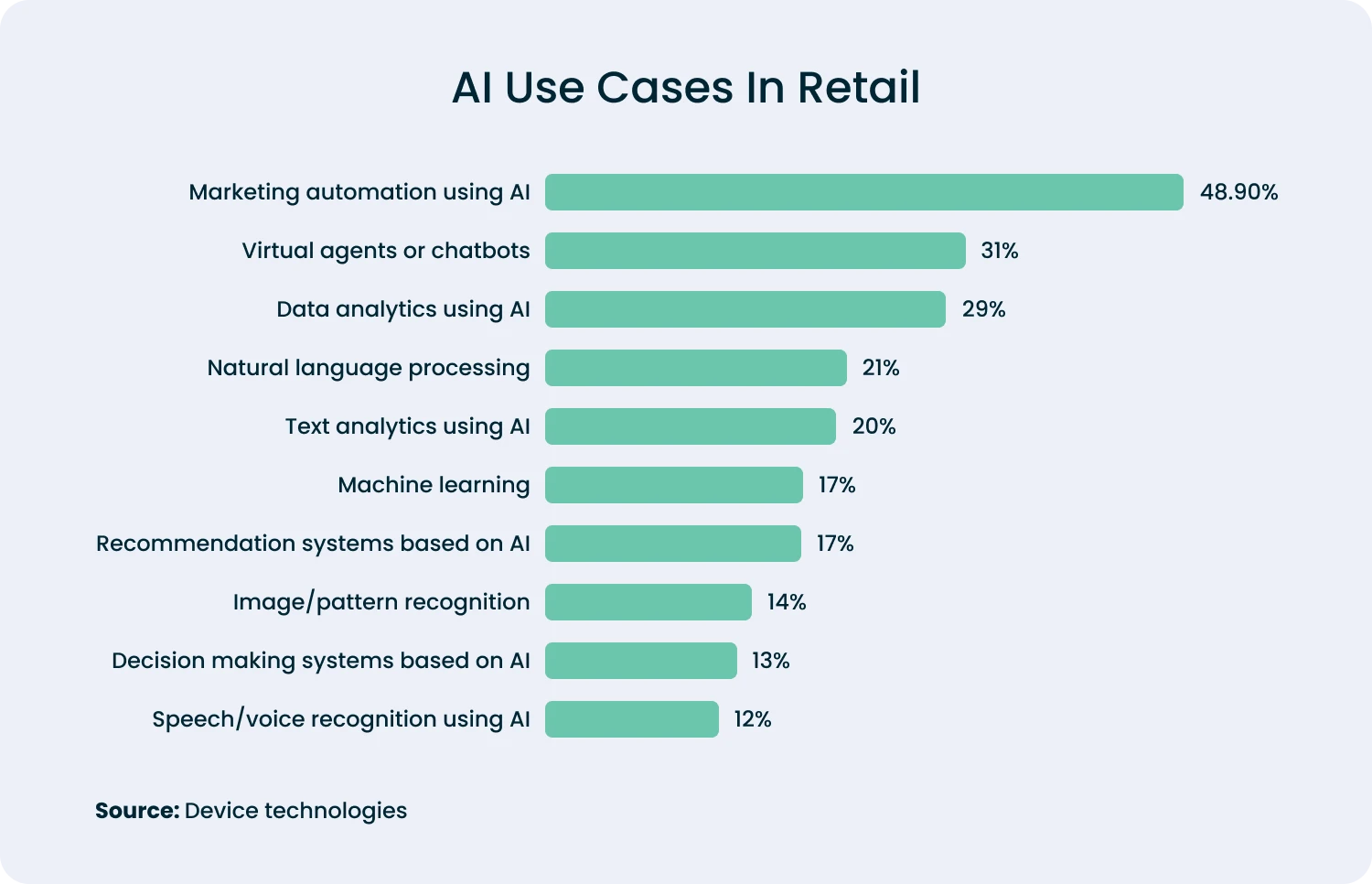
Conversational commerce for the better connection with customers
According to Forbes, 86% of consumers are ready to pay more for a better customer experience, implying that not all online stores offer quality services. But how to ensure a better connection with clients and stay on the same wavelength?
Conversational commerce is an online shopping trend that is on the way to help. It is also known as conversational marketing or chat commerce. This approach to e-commerce is used by online retailers to sell their products and services with the help of conversations.
A chat app, chatbot, voice assistant, and messaging platform are tools to deliver a conversational experience. As long as your dialogue with a client is personalized, conversational commerce serves its purpose.
According to InsightAce Analytics, the global conversational commerce market size was valued at 7,79 billion in 2024. But it is projected to reach 32,40 billion by 2034 with an annual growth of 15,4%. Conversational commerce is picking up steam, allowing online stores to compensate for the lack of physical and personal touch with their clients.
E-commerce data harmonization for more business insights
Data harmonization means bringing together different types of data into one dataset. Within a company, users should have easy access to high-quality data in agreed-upon formats. Data harmonization boosts data value and use. It helps organizations turn messy data into usable insights, cutting down on time spent finding information and reducing costs.
With data harmonization, you’ll gather more insights from various areas like consumer research and market performance. Plus, by having more structured and organized data, you’ll get to know what areas to optimize and how to get more from your data.
UGC for an engaging customer experience
User-generated content (UGC) is another trend in e-commerce used to create an emotional bond with clients. As a rule, this is any form of content created by a company’s customer. From social media posts and videos to images and textual reviews, these are diverse forms of interaction between a brand and its audience.
This customer-centric approach is valuable because it serves as a source of social proof for customers. Reasonably, 65% of brands believe that UGC helps them increase trust in their products and connect with their customers. User-generated content helps online stores improve the shopping experience, make e-commerce campaigns more personal, and increase brand awareness.
Is Your Online Store Ready For Modern Customers?
Create fast, intuitive, and conversion-driven shopping experiences across devices.
Flexible payment options for higher customer satisfaction
Flexible payment options completed in one click are always trendy in e-commerce. Whether it’s a credit card, digital wallet, or other alternative payment methods, providing a choice to clients is a way to cater to their diverse preferences. If customers are satisfied and make their purchases effortlessly, they can become regular ones.
Digital payments, including Apple Pay, PayPal, and Alipay, are the fastest-growing payment methods worldwide. The annual growth rate of such digital wallet transactions is estimated to be 18% between 2024 and 2030. It means that payment in one click as another e-commerce trend, like shopping on smartphones or mobile commerce.
Composable commerce for serving customers’ needs
E-commerce is an evolving and changing area, and clients expect even more transformations and new solutions from online stores. Composable commerce is an approach to e-commerce where businesses build their digital commerce infrastructure with the help of modular components. As a result, using these interchangeable modules, enterprises can construct their digital commerce infrastructure and achieve greater scalability and adaptability.
Composable commerce offers many benefits for business-enhancing e-commerce. Here are a few ways this e-commerce trend can ensure greater flexibility.
First, composable commerce helps businesses stay flexible by breaking systems into smaller components that can be easily modified, improved, and scaled. This means they can quickly adjust to changes in the market and technology and stay ahead in innovation.
Second, this modular approach lets businesses grow smoothly. They can handle performance drops and add new features whenever needed. So, composable commerce is a transformative solution, making systems more scalable, flexible, and efficient.
Augmented reality (AR) for transforming product visualization
Say goodbye to boring and lifeless product images and revitalize your product portfolio with augmented reality. Augmented reality is an e-commerce trend that blurs the line between online shopping and hands-on experience. For example, if you intend to buy a car, you can open the door, peer under the hood, or even take a test drive without leaving your laptop.
The magic of AR goes beyond mere visualization, allowing customers not only to find clothes but also to try them on and be sure that they fit them perfectly. Plus, you can easily customize materials and colors in real time. As a result, such involvement fosters clients’ confidence and trust in online shopping.
Social commerce for engaging audiences
Social media in retail is more than just an e-commerce trend. Social media platforms like Instagram and TikTok are full of online stores that create compelling content to influence the audience’s purchasing decisions. The social media world is fluid, spontaneous, and efficient in reaching potential clients.
Live video shopping sessions have become an interactive way for brands to showcase products in real time, engage viewers, and answer their questions. As a result, the lines between e-commerce and entertainment are blurring, resulting in an interactive experience that increases both engagement and sales simultaneously.
E-commerce as a part of a broader experience
Nowadays, e-commerce tends to penetrate other industries, allowing businesses to expand their service lines and increase ROI. In addition to their core services, companies also offer products for sale. For example, you may be familiar with a situation where you book a hairstyling appointment online. And the beauty salon offers to buy hair essentials directly on its website.
Here’s one more instance: you enroll in an educational online course and can purchase books and learning materials in a few clicks, without leaving the EdTech company’s site. These are examples of how professional services companies integrate e-commerce into their digital context, opening new revenue opportunities and providing their clients with more comprehensive experiences.
At Forbytes, we also have an on-point story demonstrating how businesses operating in other industries can use the power of e-commerce to maximize their outputs. Our client, Sharkmob, a top-tier game development company, designed a full-scale in-game store where game players can purchase items to customize their characters and improve their capabilities.
Sharkmob needed help in building a store management system and integrating it with the in-game store and the game as a whole. Our software engineers completed the task. With the help of the custom-built system Forbytes developed for the client, Sharkmob managers can keep track of the in-game purchases made by players, organize and structure game season sales, manage store assortment, view analytics, and more.
The system is one of the examples of how the e-commerce experience goes beyond retailing, being integrated into the broader context. Not only did Sharkmob add the store to their game experience, but they also created a custom management system enabling effective e-commerce operations under the hood.
Contact us if you also aim to add e-commerce offerings to your service line to boost your sales and the company’s impact. Our expert team knows how to ensure a flawless e-commerce experience at any stage of the supply chain, from back-office managers to customers engaging with the UI part of the system.
How to Future-Proof Your E-Commerce Business
With the help of the e-commerce trends mentioned above, you can future-proof your store. Here are a few more tips on how to stay ahead of the curve:
- Get your data right: Make sure your data is well-structured, accurate, and accessible across all channels. This helps you make more informed decisions and personalize customer experiences.
- Embrace tech: Keep up with the latest technology to improve efficiency, scalability, and customer engagement. AI and AR can work well for you.
- Go beyond sales: Offer more than just products. Focus on building emotional bonds with your audience, offering great support, and creating engaging experiences to keep customers coming back.
With these strategies and e-commerce trends, you can ensure your online store stays competitive in a constantly changing digital world.
Need Help with Upgrading Your E-Commerce with the Latest Tech Trends?
Looking to build an e-commerce platform or upgrade an existing online store with top tech trends? Trust this matter to the Forbytes team. With 15+ years of expertise in e-commerce and a talented team, we can share this journey with you and facilitate your growth.
At Forbytes, we offer e-commerce website development services for both B2B and B2C businesses. If you need a customized e-commerce system, we have you covered. Just contact us, and we’re always at your service.
Share:
-
-
-
Successfully copied
-
Yuliia Pushkarska
Author
As a Content Writer at Forbytes, my mission is to create captivating and informative content based on the company’s values and expertise. My articles aim to educate readers on complex technical concepts and communicate our developers’ strategies for tackling business hurdles. With a passion for storytelling and interview articles, I strive to make our tech content engaging and unique, encouraging our audience to read it in one breath.
Let's Get in Touch
Forbytes created an app that allowed users to quickly measure themselves to be fitted for custom shirts. As a result, we could increase our speed, quality, and shirt output per week. Forbytes was dedicated to delivering a solution that accurately addressed our needs.
Forbytes’ engineers and team leads worked as part of our RnD group and were directly managed by our company directors. They were both proactive and adaptable, qualities that perfectly match our needs in our fast-growing and constantly evolving environment.
Forbytes has a strong process-oriented way of leading the company, with good respect for themselves and their managers. They made a choice not to become too big but build slowly on more qualified people, which is paying off.
Niklas Hammar
COO & Business
Development at Offerta.se
Our e-commerce site saw online inquiries and orders rise after working with Forbytes. The team used top-notch expertise to inform their suggestions and improvements. Constant communication, quick responses, and prompt delivery made for a smooth and enjoyable collaboration.
The Forbytes team was very professional and demonstrated a great understanding of the business aspects. All tasks were completed above expectations. Their experts were always available, and we never needed to wait for a response or a suggested solution.

You know that businesses experience similar challenges across all sectors. For example, growing operational costs, unstable demand, pressure to scale faster with fewer resources, and others. Such problems seem relatable to almost any company, right?
However, it only appears that way. If you dive into any of these issues, you will quickly find that the solutions differ significantly and depend on the niche.
Retail businesses address rising operational costs by optimizing inventory tracking, automating order processing, or reducing returns. In the meantime, companies in other industries may focus on entirely different levers, such as internal workflow optimization or sales automation.
The same can be said about retail software development projects. While generic vendors may offer strong technical expertise, they often lack the deep understanding of retail-specific challenges. As a result, they cannot recommend the right features, integrations, and architectural decisions.
Without hands-on experience in retail workflows, even well-built, comprehensive solutions can miss critical details that directly affect sales, store operations, and customer satisfaction.
That is why our experts prepared a detailed list of retail software companies that combine technical excellence with proven domain expertise and cost-effective engagement models. With this article, you can choose a partner that offers retail software development services your company can rely on for years. Here is what we will cover:
- The importance of niche experience in software development
- Top 10 list of retail technology companies
- Common mistakes to avoid when selecting a development partner
Keep reading to make a budget-friendly choice and get long-term value from your project.
Struggling with Outdated Retail Systems?
Our team builds secure, dependable solutions for retailers.
Retail Expertise vs Generic Development: Why Specialization Matters
Why do successful retail businesses choose to work exclusively with partners that have industry experience? The answer is simple: when working on retail projects, software developers immerse themselves so deeply in the business that they begin to think like retailers themselves. As a result, you receive a solution from a team that cares about your business outcomes as much as you do.
This bold statement is supported by clear evidence. Let’s review it in more detail:
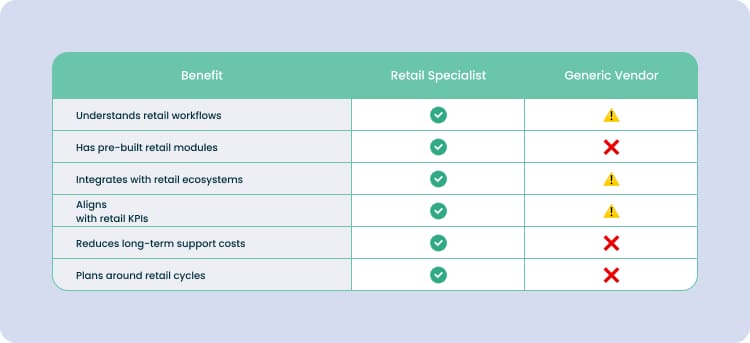
So, why should you choose an industry-focused partner over generic vendors?
Deep understanding of your workflows
Retail software developers know your challenges inside out, including seasonal spikes, fast-moving product SKUs, fulfilment rules, and omnichannel complexity. They understand that even a seemingly simple feature like real-time stock visibility can touch multiple systems and depend on numerous business rules.
By partnering with industry-focused experts, you get realistic estimates and custom retail software that accounts for operational dependencies, edge cases, and peak-load scenarios from the start.
Proven templates for retail needs
When you choose a retail software development partner with proven industry experience, you significantly reduce development costs. Most likely, the team has already solved similar challenges and can leverage pre-built modules for POS integrations, OMS, analytics, and other retail systems.
They may also have integration adapters for the existing systems, as well as established retail data models and schemas. By reusing these components, development teams shorten project timelines, optimize resource allocation, and implement your retail software solutions faster.
Lower total cost of ownership (TCO)
At first glance, partnering with a generic vendor may seem like an attractive option, especially when their pricing is lower compared to specialized providers. In reality, however, such collaborations often lead to unexpected cost increases. Common reasons include:
- Rework caused by misunderstood requirements
- Scope creep resulting from iterative fixes
- Longer QA cycles due to edge cases that retail specialists would anticipate in advance
In contrast, retail software engineers proactively identify potential pitfalls and design robust systems from the outset, which helps reduce maintenance and support costs over time.
Better alignment with your KPIs
In addition to project KPIs that are 100% trackable, retail software developers understand the metrics your e-commerce or retail business depends on. For example, customer behavior metrics, inventory turnover, sales trends, conversion rates, and more.
By keeping your KPIs in mind, retail software development teams build systems that meet both project metrics and business requirements. This ensures your retail management software supports your business from every angle and helps you grow.
Faster time to market during peak seasons
For retailers, timing is everything. You cannot afford significant downtime. Every hour your systems are not functioning properly means lost customers. Retail technology companies are fully aware of these nuances and organize projects so that your team and customers barely notice the changes.
The releases are also planned around seasonal cycles, which means updates and new features are deployed at the most convenient times. The team avoids peak sales periods and ensures smooth retail operations throughout the year.
Easier integration with retail systems
Retail tech stacks are often polyglot and sprawling:
- ERP systems / financial systems
- eCommerce platforms
- POS hardware and firmware
- Fulfillment and logistics partners
- Marketplaces and other e-commerce APIs
Vendors with retail experience have already worked with these systems and know the quirks, limitations, and best integration patterns. Generic developers frequently learn these stacks from scratch.
Awareness of retail compliance, security, and standards
Creating retail software solutions involves handing sensitive customer data, sales transactions, and regulatory requirements like PCI-DSS. A retail specialist is more likely to have:
- Documented compliance checklists
- Penetration test experience in retail contexts
- Design patterns for secure payment processing
This reduces risk for retail stores and protects their brand reputation.
As you can see, partnering with an industry-focused software development company protects your business from unexpected costs, security threats, reputational damage, and operational disruptions, ensuring smoother projects and more reliable outcomes.
Looking for a retail software development company with budget-friendly rates and proven expertise?
Submit your request, and our retail experts will reach out to you shortly.
Top 10 Retail Software Development Companies to Work with in 2026
Now, let’s look at the top-rated retail tech companies you can confidently partner with in 2026. We compiled this list based on a deep analysis of client reviews, profiles on leading rating platforms, and proven track records in delivering retail software projects.
1. Forbytes
Retail-first software engineering company with 14+ years of experience, affordable pricing, and high-level industry expertise
If you’re looking for a company that knows the retail industry inside out, you’re in the right place. Forbytes started with retail software development, and this industry remains the core specialization of their team.
Around 90% of Forbytes’ projects focus on custom retail software development, giving them extensive hands-on experience across diverse retail scenarios. The team supports everything from platform-based development, composable commerce, and retail integrations to custom system development and AI-powered analytics.
In addition to broad retail expertise, Forbytes has a dedicated Magento development team focused on platform-based projects. They also provide retail consulting services, based on their experience working with retail leaders like Home Furnishing Nordic, BHG, and Stenströms.
- Retail projects they’ve completed: PIM systems, OMS, third-party integrations, purchase management systems, AI integrations, Magento extensions, MTM tools, BI analytics tools, and more.
- Best for: Retailers looking for a deeply specialized retail partner that designs, builds, and evolves mission-critical retail systems for businesses of any size.
2. Computools
Large-scale custom development and IT consulting for complex retail environments
Computools employs more than 250 engineers who are ready to bring your project to life. As retail is one of the company’s focus industries, the team helps address a wide range of business challenges through technology, including manual workflows, inconsistencies across sales channels, siloed business processes, fragmented supply chains, and more.
- Retail projects they’ve completed: IoT tools, cash management apps, virtual try-on apps, data management platforms, and the like.
- Best for: Large retail organizations building custom, innovation-heavy retail technology at enterprise scale.
3. Itransition
Enterprise-grade technology partner for retail modernization and transformation
This retail software development company delivers both corporate and consumer applications to meet diverse client needs. The team supports retailers with custom development, consulting, software modernization, and third-party integrations.
- Retail projects they’ve completed: e-commerce consulting projects, order and inventory management solutions, POC applications, BI platforms, and others.
- Best for: Retail enterprises undergoing digital transformation and large legacy system modernization.
4. Zoolatech
Data- and AI-driven engineering team for advanced retail use cases

Zoolatech delivers practical solutions for the retail sector, helping businesses with e-commerce personalization, pricing optimization, AI adoption, inventory intelligence, and more. Although the company is relatively young, it is growing rapidly and expanding into global markets.
- Retail projects they’ve completed: B2B marketplace migrations, QA automations, advanced analytics platforms, cloud-based platforms, and beyond.
- Best for: Retailers prioritizing AI-driven personalization, pricing intelligence, and data platforms.
5. GEM Corporation
Cost-efficient development partner for operational retail systems and automation

The company’s core services include AI and data analytics, cloud platforms and services, digital transformation consulting, custom application development, system integration, and e-commerce automation. After more than a decade of steady business growth, GEM employs over 400 professionals and delivers solutions that meet international standards.
- Retail projects they’ve completed: warehouse management solutions, digital payment platforms, CRM platforms, and more.
- Best for: Retailers seeking cost-effective offshore development for operational and back-office systems.
Looking for the Retail Development Experts?
With 14+ years of industry experience, we solve the toughest retail challenges with technology.
6. Simform
Co-engineering partner for retailers scaling delivery speed and capacity

The Simform team consults, engineers, and designs software solutions to address complex business challenges with precision. They provide expertise in inventory management, headless commerce, POS solutions, and supply chain management, primarily serving enterprise and mid‑market clients.
- Retail projects they’ve completed: customer data platforms, enterprise applications, cloud integrations, IoT solutions, and the like.
- Best for: Retail companies that want to accelerate delivery by augmenting internal engineering teams.
7. Icreon
Digital transformation partner for experience-led retail brands

The company helps brands achieve what they call “digital velocity” by combining strategic consulting, digital product engineering, and customer experience transformation. Their expertise spans composable commerce, omnichannel retail experiences, digital strategy, data analytics, and cloud technologies.
- Retail projects they’ve completed: digital transformations, third-party integrations, replatforming, and others.
- Best for: Retail brands focused on omnichannel experience and composable commerce strategy.
8. Waverley Software
Long-term engineering partner for custom retail solutions

Waverley Software develops custom solutions for enterprise businesses and innovative brands. Headquartered in Palo Alto, with delivery centers across Latin America and Eastern Europe, their in‑house teams specialize in full‑lifecycle software development, from architecture and design to deployment and ongoing support.
- Retail projects they’ve completed: marketing platforms, mobile apps, blockchain solutions, and beyond.
- Best for: Enterprises requiring custom-built retail solutions with long-term engineering support.
9. Vention
Engineering talent provider for scalable retail platforms

Although not exclusively focused on retail, Vention’s deep engineering expertise and flexible engagement models help retailers modernize omnichannel platforms, strengthen backend systems, create personalized customer experiences, and integrate advanced capabilities.
- Retail projects they’ve completed: microservices commerce, retail feature enhancements, CRM customizations, and more.
- Best for: Retailers needing fast access to senior engineers for scalable platform development.
10. Cleveroad
Agile development firm for building modern retail products

Cleveroad’s expertise in real‑time inventory control, cloud-native platforms, and API integrations enables retailers to unify disparate systems and improve operational visibility. Their agile development approach, combined with ISO‑certified quality standards, ensures reliable delivery and scalability for growing retail businesses.
- Retail projects they’ve completed: marketplaces, e-commerce SaaS solutions, trading apps, and the like.
- Best for: Mid-sized retailers and startups building cloud-native retail products from scratch.
Can’t Decide on the Right Partner?
Let our retail experts review your case and turn your business needs into a perfect project plan.
Common Mistakes Retail Businesses Make When Choosing a Partner
To help you make a confident, informed choice, here are the most common mistakes we see retail businesses make and how to avoid them. Keep these points in mind to ensure a successful partnership and get a retail system that genuinely supports your business objectives.
1. Ignoring formalities in contracts
It might seem tedious, but contracts are the backbone of any successful partnership. Many retailers focus on the technical proposal and neglect key legal and operational details.
Without clearly defined deliverables, timelines, intellectual property terms, and liability clauses, you risk misunderstandings and delays. Make sure your agreement covers all critical aspects of the project upfront.
2. Choosing based on price alone
We get it: budget matters. But selecting a partner purely because their quote is the lowest can be a costly mistake. Industry data shows how expensive that mistake can become.
Our analysis found that one in six IT projects experienced cost overruns of 200% on average, and in extreme cases, projects came close to a 700% budget overrun. These blowups are typically linked to underestimated scope, weak governance, and poor execution, not ambitious features.
Generic vendors or bargain-priced offers often trigger exactly these risks, leading to hidden expenses such as rework, longer development timelines, and missed retail-specific requirements.
Instead, focus on value, experience, and proven expertise. The best partners don’t just look cheaper upfront. They protect your budget and save you money in the long run.
3. Skipping post-launch support
Your software doesn’t stop working once it’s launched. Retail solutions require ongoing maintenance, updates, and support, especially during peak seasons, promotions, or product launches.
Picking a partner without a clear post-launch support plan can leave you struggling with downtime, operational hiccups, and frustrated customers. Choose a team that will stick with you long after go-live, ensuring operational efficiency at every project stage.
4. Underestimating integration complexity
Modern retail depends on many interconnected systems, including POS systems, ERPs, accounting software, eCommerce platforms, inventory management, analytics, and more. Integrating these systems is rarely straightforward.
In the research on public-sector IT projects, integration challenges appear as a distinct risk factor. The analysis showed that complexity is a major contributor to cost overruns and schedule extensions in real deployments.
Retail specialists anticipate these challenges and design seamless integration workflows, but generic vendors may not. Ignoring the complexity can result in slow performance, data inconsistencies, and operational bottlenecks.
Follow our tips, and you will find a perfect partner that matches your budget, expectations, and long-term project goals.
Entrust Your Project to Retail Development Pros
Of course, choosing a retail software development company cannot be done at once. You should contact multiple vendors, gather information on their pricing, portfolios, customer reviews, and more. Equally important are the soft skills of your potential partner. The team should be transparent, approachable, and responsible.
If you are looking for exactly this type of partner, leave us a note.
During the discovery call, we’ll get to know each other, analyze your case, and present our capabilities. No obligations, no stress. Just a straight-to-the-point 30-minute conversation to help you decide if we are the right fit.
Share:
-
-
-
Successfully copied
-
Anzhelika Danielkievych
Author
My mission at Forbytes is to help our IT experts share complex information in plain language. The articles we produce reflect our expertise and help readers keep pace with the market trends and insights. We strive to educate, inspire, and empower our audience through compelling content that tackles the intricacies of the IT world and makes it accessible to all.
Let's Get in Touch
Forbytes created an app that allowed users to quickly measure themselves to be fitted for custom shirts. As a result, we could increase our speed, quality, and shirt output per week. Forbytes was dedicated to delivering a solution that accurately addressed our needs.
Forbytes’ engineers and team leads worked as part of our RnD group and were directly managed by our company directors. They were both proactive and adaptable, qualities that perfectly match our needs in our fast-growing and constantly evolving environment.
Forbytes has a strong process-oriented way of leading the company, with good respect for themselves and their managers. They made a choice not to become too big but build slowly on more qualified people, which is paying off.
Niklas Hammar
COO & Business
Development at Offerta.se
Our e-commerce site saw online inquiries and orders rise after working with Forbytes. The team used top-notch expertise to inform their suggestions and improvements. Constant communication, quick responses, and prompt delivery made for a smooth and enjoyable collaboration.
The Forbytes team was very professional and demonstrated a great understanding of the business aspects. All tasks were completed above expectations. Their experts were always available, and we never needed to wait for a response or a suggested solution.

Ensuring your website feels good to use is key to turning visitors into customers. After all, your competitors are only a quick search away, so you need to give people a reason to stay. That means keeping your eCommerce website design fresh, easy to navigate, and visually appealing.
In this article, we’ll walk through what’s shaping UX for eCommerce right now. You’ll get a clear view of the trends that matter and insights that can help you decide what’s worth adopting in your own business. Here are the UX design trends set to grow this year:
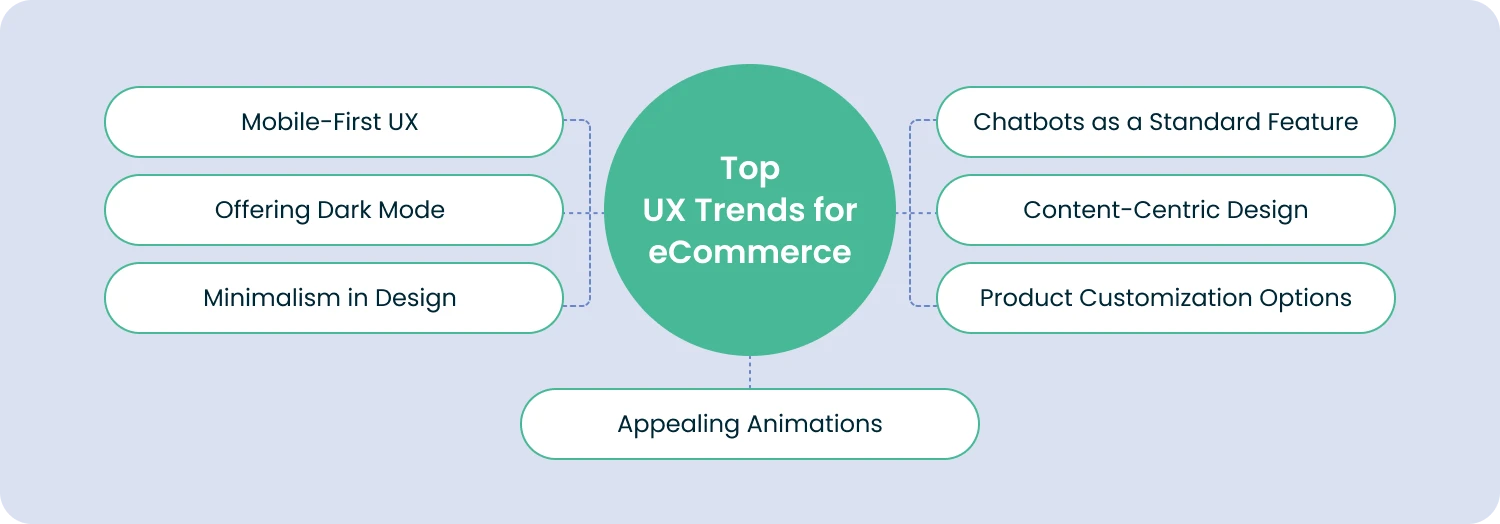
1. Mobile Is King
It’s no secret anymore: your eCommerce website has to work beautifully on mobile. Shoppers have fully embraced their phones, and the numbers prove it. In 2025, 91% of online shoppers worldwide used smartphones to make purchases. And there’s more. Companies with strong omnichannel strategies saw 9.5% year-over-year revenue growth, while those lagging behind grew by just 3.4%.
Dark mode isn’t new, but its rise in popularity definitely is. Today, more than 82% of smartphone users prefer using dark mode, which is why so many eCommerce sites now offer a simple toggle to switch between light and dark themes. Even among Apple users, about 59% choose to browse in dark mode. No surprise that apps, social platforms, and online stores are all jumping on board.
But dark mode isn’t just about looks. It actually helps save battery life, especially on OLED screens, which use more power to display bright colors. A quick example: if you watch YouTube at 50% brightness, switching to dark mode can cut energy use by around 47%. So yes, it’s a small but real way to reduce environmental impact too.
Beyond that, dark mode is great for accessibility. It can reduce eye strain, making it easier for visitors to browse your store comfortably and stay longer.
Giving shoppers the freedom to choose how they view your site adds convenience, flexibility, and a sense of control. And according to UX designers, dark mode is only going to get more popular in 2026.
3. Embracing Minimalism
Minimalism and simplicity continue to shape eCommerce UX in 2026. Think of it this way: your products should take center stage, and your interface should quietly support them.
That’s why modern eCommerce design leans toward clean layouts, lots of breathing room, bigger fonts, and straightforward navigation. It also ties into a broader UX eCommerce trend: making online stores easier and more accessible for everyone.
Minimalism follows a pretty intuitive rule. The more choices people have, the longer it takes them to make one. So trimming away anything unnecessary is key.
Keep your pages clean and focused, especially on mobile, where space is limited and attention spans are shorter. A simple, uncluttered product page tends to appeal to a wider audience than something overly decorative or complex.
To keep your UX design truly minimalistic, here are a few practical tips to follow:
- Show only what matters. Cut anything that doesn’t help the user move forward. Every element on the page should have a clear purpose.
- Give your layout room to breathe. Don’t clutter your pages with effects or visuals just for the sake of filling space. A bit of empty space makes your site feel lighter and more comfortable to explore.
- Keep things flat and simple. A restrained color palette, clean fonts, and subtle effects not only look modern but also age well. This kind of design tends to stay relevant for years.
- Use clean, uncluttered images. Crowded visuals will instantly break the minimalist feel. Aim for clear contrast and straightforward product shots.
Minimalism might look effortless, but making everything work together seamlessly takes skill. If you want your store to feel polished, intuitive, and beautiful, partnering with an experienced UI/UX designer can make all the difference.
4. Appealing Animations
Our eyes naturally gravitate toward movement, which is why animations can be such a powerful tool in eCommerce UX. They help guide your visitors, highlight what matters, and make the whole experience feel more dynamic. You’ll be seeing more of three types of animations in particular:
- Buttons. Even small button animations can make the experience feel more alive. A simple color change on click is enough to show something is happening, while more advanced effects (like a quick animation of an item dropping into the cart) add a bit of delight to the shopping moment.
- Hovers. Hover effects appear when someone moves their cursor over an element. They act like little previews, showing users what to expect if they click. Their interactive feel keeps visitors curious and encourages them to explore more of your site.
- Cinemagraphs. These are images with subtle, looping animations, often used in banners or backgrounds. Cinemagraphs add a touch of movement to an otherwise still page, giving your eCommerce site a bit more atmosphere and personality.
Using animations on your eCommerce site can bring several valuable benefits:
- Stand out from the competition. Many websites now use animations to grab attention, whether that’s through animated customer reviews, storytelling elements, or highlighting key actions. Done well, these touches can make your brand more memorable and help you rise above look-alike stores.
- Improve your SEO performance. Sites with animated, engaging UX elements are 53 percent more likely to rank higher on Google. Search engines reward sites that offer interactive, user-friendly experiences, nudging other retailers to keep leveling up their design.
- Increase conversions. If you’re looking to boost your eCommerce metrics, animations can help. They naturally draw the eye, keep visitors engaged longer, and guide them toward taking action — all of which contribute to better sales performance.
That said, not everyone enjoys motion on a page. For some users, too many moving elements can be distracting or even uncomfortable. It’s a good idea to offer an option to turn animations off so every visitor can have a smooth, comfortable experience on your site.
5. Chatbots as the Norm
Chatbots are becoming a major time-saver for businesses. Recent statistics show they can help companies save up to 11 billion dollars and almost 2.5 billion hours. It’s a huge win, especially for teams that operate around the clock with limited staff. When no one is available to jump into a chat, a well-built bot can step in and keep customers supported.
As AI has improved, chatbots have become more common and far more capable. Today, about 40% of companies across the US, Europe, and China use live chat tools to engage customers.
A chatbot can guide visitors through your eCommerce site step by step, answer basic questions, and even help them find products. In many cases, they act like digital assistants, handling routine inquiries so shoppers get what they need without waiting for a human to respond.
Businesses generally have two types of chatbots to choose from:
- Command-based chatbots. Also known as rule-based bots, these follow a script. They use pre-written answers and actions, so what they can do depends entirely on the options you’ve set up. If a user chooses a specific question or prompt, the bot delivers the matching response.
- ML-powered chatbots. These are the more advanced version. They learn from real customer experience and get better over time. Because they understand context, they can respond more naturally and handle requests that don’t fit neatly into predefined scripts.
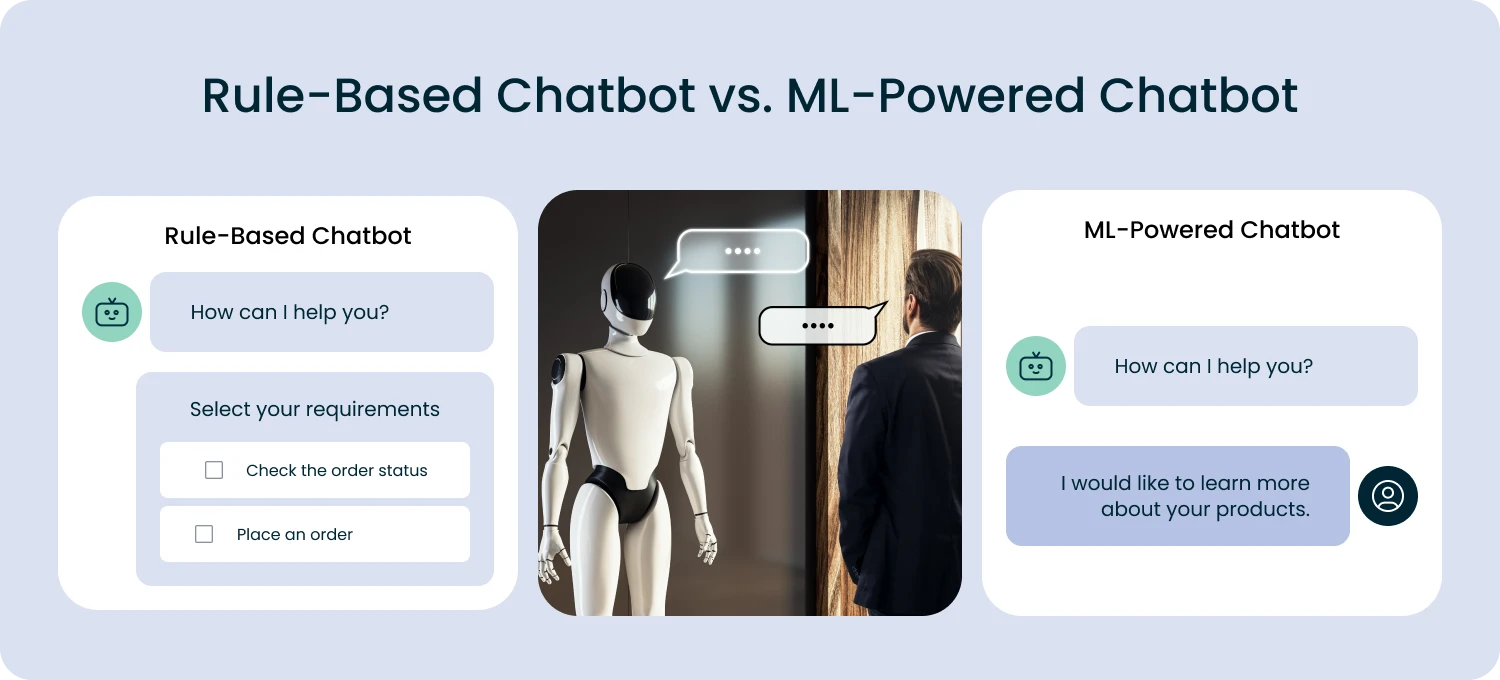
Both types can take on tasks that would normally fall to a customer service agent. They answer questions, help shoppers find products, and guide them through the site. Some even analyze user behavior to offer more personalized support. With capabilities like these, it’s no surprise that chatbots have become one of the biggest trends in eCommerce app design this year.
6. Content-Centric Design
Your website shouldn’t just promote your products. It should also inform, educate, and genuinely help your customers. That’s where content comes in. Blog articles, guides, and useful tips can do a lot for your store, from drawing attention to your products, to explaining what makes them great, to offering advice shoppers actually care about.
In eCommerce UX, content is becoming an increasingly important part of the experience. Instead of treating it as an add-on, many brands now use content as a core promotional tool. Done well, it creates a smoother, more engaging journey for your visitors and makes your products feel more appealing.
Here are a few things that define this growing trend:
- Balance your content with space. We’re all surrounded by content every day, so it’s easy to think that more is always better. But in eCommerce design, the opposite is true. Your pages need breathing room. A good balance of whitespace and text helps users pause, absorb information, and move comfortably to the next section. How much content you actually need depends on your niche, so it’s worth checking what top competitors are doing to see what works in your space.
- Cut the clutter. Take a close look at your content and remove anything that doesn’t serve a purpose. Too much filler makes the page feel overwhelming. Keep the meaningful parts and let your users focus on what really matters.
- Follow a clear structure. A well-organized layout helps people navigate your store without thinking twice. A UX expert can help you understand how visitors behave and how to place elements where they naturally expect them. For instance, most users look for a search bar in the top right corner and a home button in the top left — simple conventions that make their experience feel intuitive.
And here’s where content really shines: imagine reading an article about a product and being able to add it to your cart right there without leaving the page. Many stores now make this possible through interactive images and embedded product links. This kind of content-centric design creates a smooth, seamless shopping experience your customers will appreciate.
7. The Opportunity to Customize Products
Giving customers the option to customize products can completely elevate their shopping experience. Letting people choose colors, sizes, shapes, or designs makes the product feel more personal. After all, it makes the entire journey feel more fun. When shoppers can preview what their customized item will look like, they feel more confident and more connected to what they’re buying.
Of course, offering customization isn’t something you set up overnight. It takes planning, development work, and thoughtful UX. Bringing in a UX professional is often the smartest move. They can help turn your ideas into intuitive, easy-to-use features that your audience will genuinely enjoy.
Boost Your eCommerce Growth with Smarter UX
In this article, we explored the key UX trends shaping eCommerce and why they matter. At the end of the day, great UX is what turns curious visitors into loyal customers. And that applies just as much to online stores as it does to physical ones.
By keeping up with UX trends and adapting them to your business, you can turn your eCommerce website into a place people enjoy visiting — and returning to.
If you’d like a hand refining your eCommerce UX or polishing your system design, feel free to reach out. We’re always happy to help your website look and feel its best.
Share:
-
-
-
Successfully copied
-
Anzhelika Danielkievych
Author
My mission at Forbytes is to help our IT experts share complex information in plain language. The articles we produce reflect our expertise and help readers keep pace with the market trends and insights. We strive to educate, inspire, and empower our audience through compelling content that tackles the intricacies of the IT world and makes it accessible to all.
FAQ
What's the difference between UI and UX?
UI is everything you see on a website — the layout, the buttons, the visuals, the overall look and feel. It’s the part you interact with on the surface.UX is about the experience behind those visuals. It’s how easy it is to use the site, how smoothly the features work, and how a person feels as they move from one step to the next. If something is confusing or frustrating, that’s a UX issue.If you want a clearer breakdown of how UI and UX differ, our recent article walks through it in detail — feel free to give it a read.
Why is UX design so important in eCommerce?
User experience is what sets the tone for every interaction a customer has with your brand. It’s how you draw people in, keep them engaged, and guide them toward making a purchase. Strong UX always starts with understanding your users, and it can lift every part of your sales funnel — boosting conversions, increasing lifetime value, building loyalty, and strengthening your brand connection.And since your customers may be miles away with no real human presence to rely on, UX becomes your stand-in. It’s how you bridge the distance, convey emotion, and make the online experience feel welcoming and personal.
I need to improve my UX. Can you help?
Absolutely. We offer professional UI/UX design services and have extensive experience in eCommerce development. Our team can review your current website, evaluate it against key usability standards, and identify clear opportunities for improvement. If you’d like to explore how we can help, just reach out — we’d be happy to talk.
Let's Get in Touch
Forbytes created an app that allowed users to quickly measure themselves to be fitted for custom shirts. As a result, we could increase our speed, quality, and shirt output per week. Forbytes was dedicated to delivering a solution that accurately addressed our needs.
Forbytes’ engineers and team leads worked as part of our RnD group and were directly managed by our company directors. They were both proactive and adaptable, qualities that perfectly match our needs in our fast-growing and constantly evolving environment.
Forbytes has a strong process-oriented way of leading the company, with good respect for themselves and their managers. They made a choice not to become too big but build slowly on more qualified people, which is paying off.
Niklas Hammar
COO & Business
Development at Offerta.se
Our e-commerce site saw online inquiries and orders rise after working with Forbytes. The team used top-notch expertise to inform their suggestions and improvements. Constant communication, quick responses, and prompt delivery made for a smooth and enjoyable collaboration.
The Forbytes team was very professional and demonstrated a great understanding of the business aspects. All tasks were completed above expectations. Their experts were always available, and we never needed to wait for a response or a suggested solution.

If you’re the owner of a B2B eCommerce business, you might think you have enough clients and don’t need to worry because eCommerce is booming. You stick to the traditional business-to-business model and have no plans to change.
But things aren’t as simple as they seem. First, client expectations are rising. That’s why they can choose more innovative and advanced options. Second, you might face pressure from competitors who are experimenting and innovating. In this scenario, you risk losing clients, which could lead to decreased revenues and an uncertain market position.
So, how can you stay on buyers’ radar and withstand fierce competition in digital commerce? The answer is simple: explore and embrace B2B eCommerce trends. From AI implementation and advanced eCommerce platform development to data analytics and personalization, these are trends you can’t ignore.
In this article, we’ll present the top 6 business-to-business eСommerce trends for 2026 that you should consider to pave the way for operational efficiency and rapid business growth. Let’s dive in.
What’s Happening in the Global B2B eCommerce?
As the digital world changes, the global B2B eCommerce market is expected to reach $39, 768 billion by 2028, growing from $21,222 billion in 2024, highlighting huge growth opportunities for businesses in international markets. The annual growth rate is projected to be 17% during the forecast period.
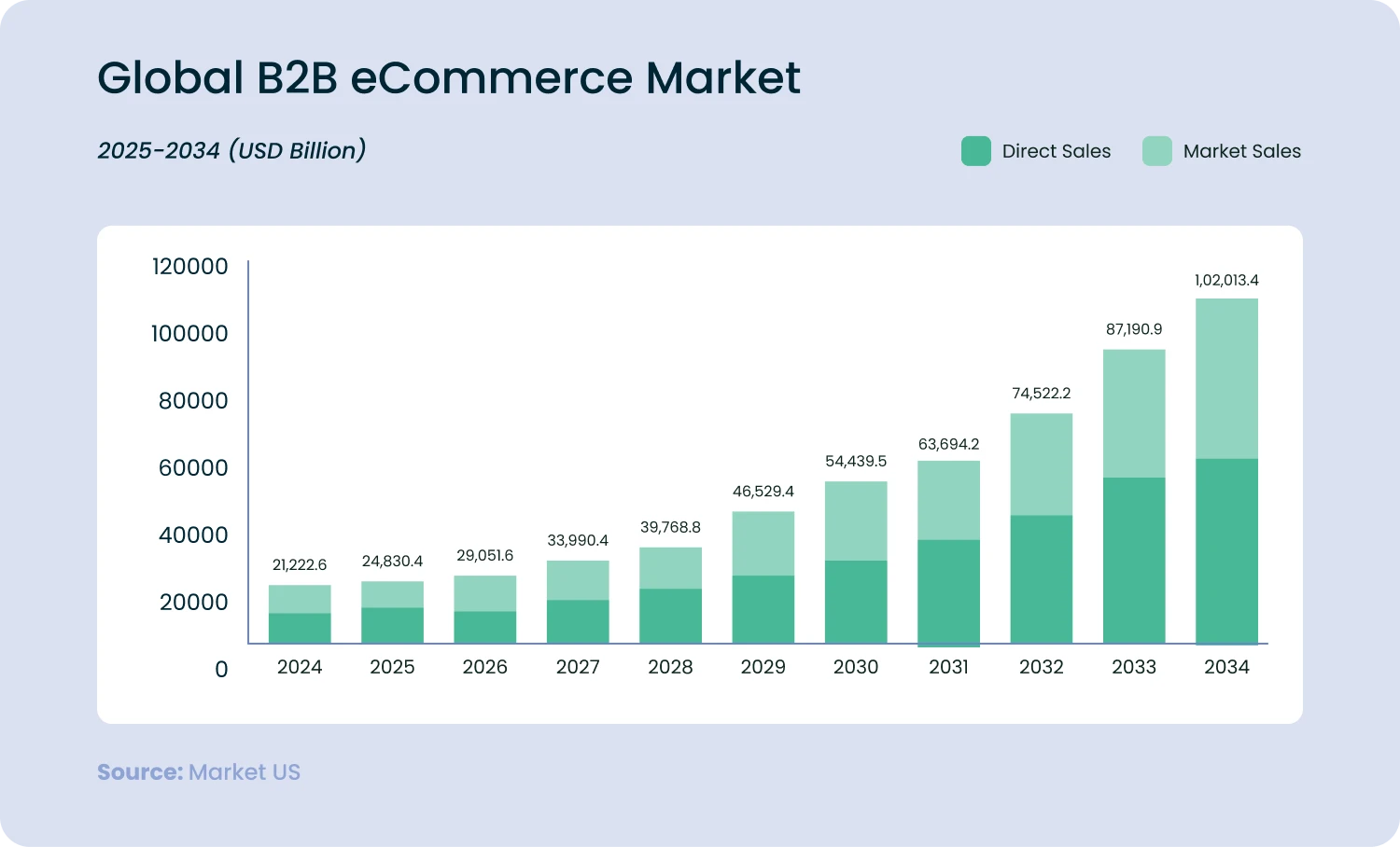
These figures prove not only a sustained development in B2B eCommerce but also the importance of staying up-to-date with digital transformation to take full advantage of the industry.
Today, the Asia-Pacific (APAC) region holds the largest market share in the global eCommerce arena. This dominance is driven by rapid digitalization. Countries like China and India have experienced significant growth due to the increased Internet visibility over the past decade. As a result, this digital boom encourages businesses to use online platforms for trade, boosting eCommerce activities.
Buyers are also driving the growth of B2B eCommerce. The majority of buyers use their mobile devices for research and purchasing because it allows them to shop without being distracted from work. That’s why buyers use social media platforms and digital channels to make purchases.
All these processes underline the evolving nature of the B2B eCommerce landscape and encourage investment in this area. It offers numerous opportunities for businesses to innovate, improve their online shopping experience, and drive sustainable growth.
The 6 B2B E-Commerce Trends Set to Define 2026
If you start looking for B2B eCommerce trends to fuel your business, you’ll be surprised by how many offerings there are around. To avoid getting lost in them, we recommend focusing on tech trends as their effects are more long-lasting and will help you stand out from the crowd. Here are the key trends our team advises you to follow:
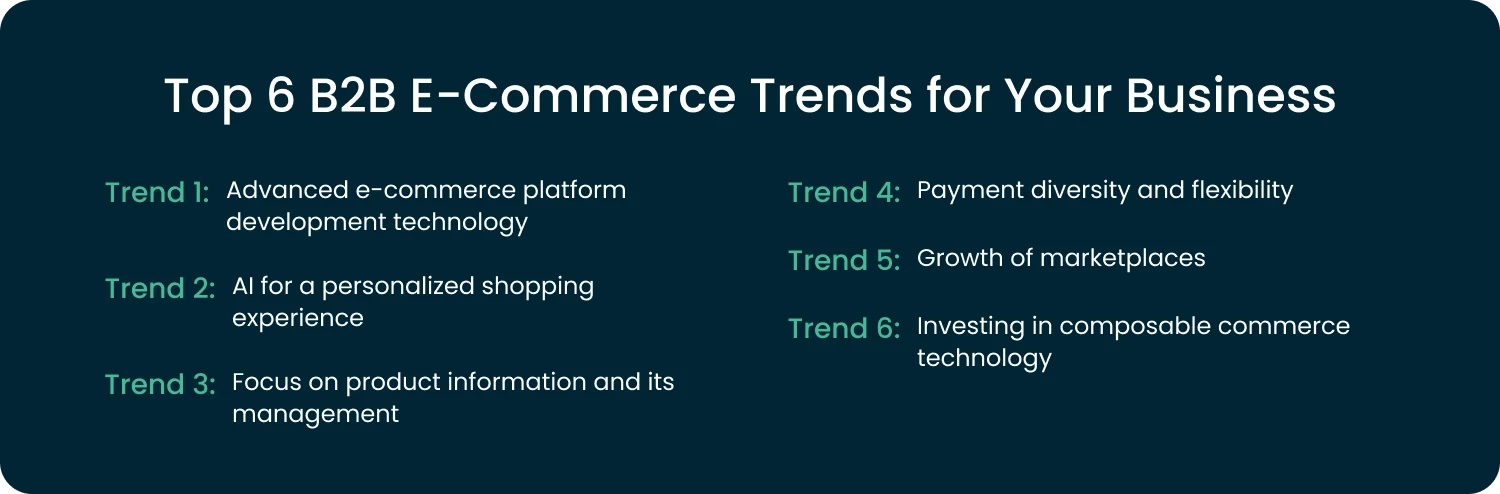
Trend 1: Advanced eCommerce platform development technology
If you’re planning a digital transformation, a good idea for you will be to start with developing an online store or making an existing one more advanced. US B2B eCommerce has defined this as a top priority for further digitalization and better responding to buyers’ needs. Even if you want to choose from existing e-commerce platforms, consider whether these are flexible and scalable. Plus, you should ensure that the chosen software supports relevant functionality.
Most importantly, your platform should keep up with changing consumer behavior: how your buyers explore products, compare different options, and make purchase decisions online. Modern B2B buyers also expect self-service portals that let them place orders, track shipments, manage invoices, and reorder products without relying on sales reps.
A flexible, scalable platform shapes the online shopping experience your clients get. So, make sure your platform does more than just perform — it grows with your business.
In this case, you have two options to choose from. You can build an eCommerce solution from scratch or expand the existing one with extra features and capabilities. Both variants can help you succeed in the business-to-business eCommerce market.
At Forbytes, we build eCommerce solutions that solve challenges and meet user needs. From responsive online shops to automation tools, we ensure your venture is scalable, secure, and positioned for success. Plus, we can integrate digital tools like customer relationship management systems, PIM, DAM, ERP, and payment apps into your current eCommerce solution.
Trend 2: AI and machine learning for a personalized shopping experience
Another eCommerce trend that has already turned into the mainstream is the use of AI to personalize the shopping experience. Reasonably, many companies use AI-driven personalization tactics and get an increase in revenue because of the delivery of tailored services.
AI also gives you a heads-up on what’s coming next. With demand forecasting, sales rep teams can predict customer needs and fine-tune marketing strategies before the market even changes.
With Forbytes’ AI integration services, you can fuel your business systems with AI and machine learning and make your operations more accurate and efficient. For example, we can build an AI-powered chatbot for your eCommerce site to ensure instant customer support and better respond to clients’ requests.
Trend 3: Focus on product information and its management
As one of the pain points for B2B buyers is finding products and up-to-date details on them, eCommerce businesses pay much attention to product information. Companies using PIM software report an increase in overall operational efficiency when managing product information across multiple channels.
That’s why product information management (PIM) software has become a popular B2B eCommerce trend among businesses. PIM helps collect and distribute product information across diverse channels.
At Forbytes, we develop management systems and tools, including PIM software, to handle diverse retail operations. Our objective is to help companies manage product data seamlessly. That’s why we deliver scalable, customizable tools that optimize processes and support business goals.
Trend 4: Payment diversity and flexibility
B2B buyers expect more platform capabilities not only in their shopping experience but also in how they pay for their purchases. That’s why eCommerce businesses offer multiple payment options that align with clients’ financial preferences, budgeting, and cash flow. This B2B e-commerce trend is picking up steam.
First, B2B companies offer various digital payment methods. Businesses that offer multiple payment options see a 20% increase in conversion rate. Reasonably, many clients prefer flexible payment terms. Plus, flexible payment options significantly improve customer satisfaction, as buyers can align purchases with their financial workflows and cash flow needs. This reveals the value of offering diverse and flexible payment methods to achieve desired business outcomes.
At Forbytes, we offer payment integration services to create various payment options and make online purchasing more convenient. This is an effective way to reach a broader audience and shorten sales cycles.
Trend 5: Growth of marketplaces
Another B2B e-commerce trend to consider is the growth of marketplaces. Marketplaces make it easier for businesses to access products and services from diverse suppliers, expanding product choices.
The popularity of marketplaces encourages customer groups to adopt them as a solution for boosting efficiency and achieving desired outcomes.
Marketplace development is one of the services we offer to our clients. With our help, creating a marketplace can unlock new revenue opportunities for your business. We’ll share our expertise to help you quickly enter new markets.
Trend 6: Investing in composable commerce technology
Today, more and more eCommerce companies are investing in composable commerce systems. These are flexible and scalable solutions that allow for optimizing the customer experience without the need to replace the entire system. By investing in composable technology, you’ll quickly adjust your eCommerce site to market changes and efficiently integrate with other systems.
At Forbytes, we can help you build a composable commerce architecture, ensuring scalability and stable performance and boosting your competitive advantage.
Want to See How Top Trends Work in Practice?
Leave a request, and we’ll create a free implementation plan for you.
How to Decide Which B2B eCommerce Trends Are Worth Pursuing?
We’ve listed the major tech trends, but not every trend is worth pursuing. Some may be valuable, while others might be less important for your business. We’ll help you choose the most relevant ones for your company. Here are a few points to consider when determining which trends will be a good fit for your digital platform.
The situation in the industry
When picking relevant B2B eCommerce, evaluate the industry landscape and stay aware of its data to understand where eCommerce is headed. This information will help you determine which technological advancements to invest in and which trends are worth your effort.
Plus, identify the bottlenecks the chosen technology can address and any gaps that can be spotted, like optimizing your inventory management and supply chain operations for rapid delivery.
Customer behaviors
The next point to consider is buyer behavior. To do this, you need to assess clients’ preferences and interests to understand their needs. The strength of the data-driven eCommerce strategy is that you can access customer data and use it to make more informed decisions.
You can also refine your marketing strategies based on customer data to deliver more tailored and targeted campaigns that resonate with your audience. Today’s buyers expect personalized customer experiences, from product recommendations that make sense to content that speaks their own language. All these aspects contribute to a seamless online experience.
Feedback from B2B customers
Review feedback from your B2B customers, as this helps you understand their pain points and find relevant solutions. Feedback from current clients will guide your sales teams to the trends you should adopt to succeed and better respond to customers’ needs. It also gives you a clear picture of customer expectations, what your buyers really want and value.
Competition
No less important is the competition in the market. Evaluate what your rivals are doing, which B2B eCommerce trends they’re embracing, and how those trends are working for them. The more companies adopt a certain trend, the more successful it’s likely to be.
Also, consider how your eCommerce platform can support these trends, give you a competitive edge, and help meet changing buyer expectations. If your site is advanced and innovative, you have a higher chance of a successful global expansion.
Unsure which B2B e-commerce trend to pursue? Get a free consultation to help you decide which trends are worth implementing for your business success.
The Future of B2B eCommerce
With the tech B2B e-commerce trends mentioned above, your business won’t be the same anymore. They will open more opportunities for scaling your company and fueling your e-commerce software with extra features for a better customer experience. All these innovations help both you and your business buyers achieve steady growth and stay agile in the market.
Ready to transform your business operations? Contact us today to learn how we can help you stay ahead. Let’s build your eCommerce platform together!
Share:
-
-
-
Successfully copied
-
Yuliia Pushkarska
Author
As a Content Writer at Forbytes, my mission is to create captivating and informative content based on the company’s values and expertise. My articles aim to educate readers on complex technical concepts and communicate our developers’ strategies for tackling business hurdles. With a passion for storytelling and interview articles, I strive to make our tech content engaging and unique, encouraging our audience to read it in one breath.
FAQ
Why should my business care about B2B eCommerce trends?
The market is shifting fast. Staying updated helps you stay competitive, meet evolving buyer expectations, and invest in tools that actually move the needle for your business.
How does AI impact B2B eCommerce?
AI helps with everything: smarter search, personalized recommendations, demand forecasting, automated workflows, and real-time insights. It makes your entire buying process faster, more accurate, and more intuitive.
What requirements should an eCommerce platform meet to stay future-proof?
Your platform must be flexible, scalable, and customizable. and ready to support AI tools, automation, advanced workflows, and integrations that keep you ahead of the curve.
Let's Get in Touch
Forbytes created an app that allowed users to quickly measure themselves to be fitted for custom shirts. As a result, we could increase our speed, quality, and shirt output per week. Forbytes was dedicated to delivering a solution that accurately addressed our needs.
Forbytes’ engineers and team leads worked as part of our RnD group and were directly managed by our company directors. They were both proactive and adaptable, qualities that perfectly match our needs in our fast-growing and constantly evolving environment.
Forbytes has a strong process-oriented way of leading the company, with good respect for themselves and their managers. They made a choice not to become too big but build slowly on more qualified people, which is paying off.
Niklas Hammar
COO & Business
Development at Offerta.se
Our e-commerce site saw online inquiries and orders rise after working with Forbytes. The team used top-notch expertise to inform their suggestions and improvements. Constant communication, quick responses, and prompt delivery made for a smooth and enjoyable collaboration.
The Forbytes team was very professional and demonstrated a great understanding of the business aspects. All tasks were completed above expectations. Their experts were always available, and we never needed to wait for a response or a suggested solution.